

Introduction
Data analysis has always been about turning raw data into meaningful insights. Until recently, the process depended heavily on manual effort, predefined statistical models, and structured datasets. The emergence of Generative AI is changing the game, introducing automation, adaptability, and human-like decision-making capabilities to analytics.
Generative AI is reshaping how businesses extract insights, from automating tedious data preparation to generating synthetic data for model training. While it’s a significant breakthrough, it’s not without challenges—bias, accuracy, and security concerns remain hot topics.
Let’s explore the real impact of generative AI on data analysis—how it’s helping, where it’s struggling, and what the future holds.
Generative AI in Data Analytics: What’s Changing?
At its core, generative AI is different from traditional AI models. Instead of just analyzing historical patterns, it can create new data, generate insights dynamically, and even automate complex decision-making. This ability makes it invaluable for modern data-driven businesses.
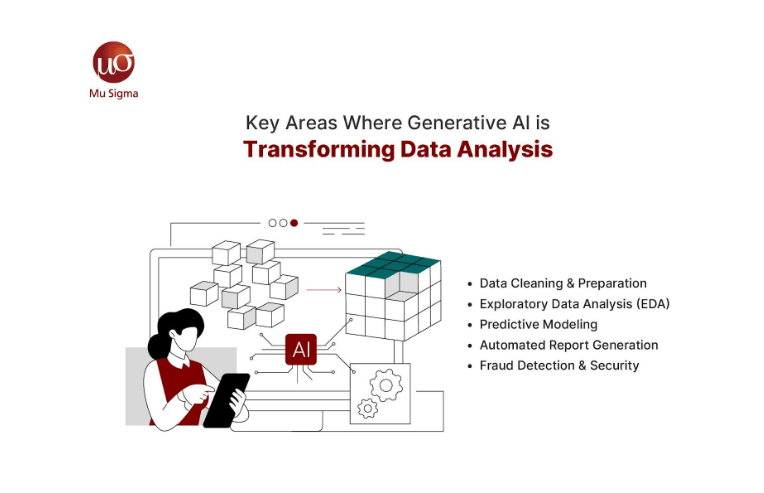
Key Areas Where Generative AI is Transforming Data Analysis:
- Data Cleaning & Preparation: AI automates data wrangling, reducing human intervention.
- Exploratory Data Analysis (EDA): AI suggests trends, outliers, and correlations.
- Predictive Modeling: AI generates synthetic data for better model accuracy.
- Automated Report Generation: AI translates raw data into human-readable insights.
- Fraud Detection & Security: AI analyzes real-time anomalies for threat detection.
According to an MIT Sloan study, 80% of data scientists’ time is spent on data preparation alone—a pain point Generative AI can significantly reduce.
2. Automating Data Cleaning: The Hidden Hero
Ask any data scientist, and they’ll tell you that data cleaning is the least glamorous but most important task in analytics. Even the best machine learning models fail if the data is noisy or inconsistent. For example, Google’s AutoML Tables uses AI-powered feature engineering to detect and clean messy datasets, reducing manual effort by half.
How Generative AI is Helping:
- Detecting Missing Values: AI predicts missing data points based on contextual patterns.
- Fixing Data Inconsistencies: AI standardizes formats, resolves duplicates, and normalizes entries.
- Automating Labeling: AI-assisted labeling speeds up supervised learning processes.
Generating Insights from Raw Data—Faster & Smarter
Instead of running SQL queries or Python scripts, analysts can now converse with AI to get insights. AI-powered Natural Language Processing (NLP) allows users to ask plain English questions about data.
Real-World Application:
- BI Dashboards: AI recommends KPIs, trends, and custom reports dynamically.
- Conversational Data Analysis: AI tools like ChatGPT Enterprise, Tableau AI, and Power BI Copilot enable interactive data queries.
- Automated Report Writing: AI drafts executive summaries of key business metrics.
Predictive & Prescriptive Analytics: Beyond Just Forecasting
Traditional predictive models rely on historical data, but generative AI takes it further by generating synthetic data to improve predictions.
How AI is Enhancing Predictive Analytics:
- Generating Missing Data Points: AI fills data gaps for better training sets.
- Anomaly Detection: AI flags irregular trends before they become risks.
- Scenario Simulation: AI creates “what-if” scenarios for better risk management.
In healthcare, AI models trained on synthetic patient records can more accurately predict disease outbreaks than traditional models.
The Role of Generative AI in Fraud Detection
Fraud detection systems have traditionally relied on rule-based systems, but generative AI introduces adaptive learning, allowing financial institutions to spot fraud in real-time. For instance, PayPal’s AI fraud detection system uses deep learning to analyze millions of transactions per second, flagging fraud in milliseconds.
How It Works:
- AI examines transaction patterns to detect inconsistencies.
- AI learns from historical fraud cases to flag suspicious activity.
- AI automates risk assessments, reducing false positives.
Synthetic Data Generation
One of the biggest barriers in data analytics is privacy and compliance. Generative AI is solving this issue by creating synthetic data—fake but statistically identical data—so businesses can train AI models without compromising user privacy.
Why Synthetic Data Matters:
- Regulatory Compliance: Meets GDPR & HIPAA requirements.
- Bias Reduction: Eliminates racial, gender, or socio-economic bias in training data.
- Security & Anonymization: Protects real customer information.
The Limitations of Generative AI in Data Analytics
Despite its capabilities, Generative AI is not perfect. Here’s why:
- Bias in AI Models: If training data is biased, AI-generated insights will be biased, too, potentially leading to skewed analysis and unfair decision-making.
- Overfitting Risks: AI may “hallucinate” patterns that don’t exist, creating misleading conclusions that could impact strategic business decisions.
- Lack of Explainability: AI-driven decisions can be challenging to justify, especially in regulated industries like healthcare and finance, where transparency and accountability are crucial.
- Computational Cost: Training and deploying large-scale AI models requires significant computational power, making them expensive and resource-intensive. This may not be feasible for all businesses.
These limitations highlight the need for human oversight in AI-driven data analytics. While AI can optimize and automate many aspects of data processing, human judgment remains critical in validating and interpreting AI-generated insights to ensure accuracy and ethical use.
What’s Next? The Future of AI-Powered Data Analytics
As AI evolves, the data analysis field will undergo transformative changes.
- Explainable AI (XAI): One key development area is Explainable AI (XAI), ensuring that AI-driven decisions are transparent, interpretable, and accountable. This is especially critical in regulated industries where understanding how conclusions are reached is just as important as the insights themselves.
- Autonomous AI Pipelines: Another major advancement is the rise of Autonomous AI Pipelines, where AI will take charge of the entire data workflow, from ingestion to visualization. By automating these processes, businesses will experience unprecedented efficiency and scalability in their analytics operations.
- AI Assistants: Personalized AI Assistants will become increasingly sophisticated. They will tailor insights to individual users based on their needs and queries. These assistants will enhance business intelligence tools, providing relevant and actionable real-time recommendations.
Finally, AI-augmented decision-making will redefine the role of human analysts. Instead of replacing them, AI will serve as an influential collaborator—offering suggestions, identifying patterns, and allowing professionals to focus on strategic decision-making rather than manual data processing.
Conclusion
Generative AI significantly transforms data analysis by streamlining workflows, enhancing predictive capabilities, and increasing data accessibility. Nonetheless, it is not a complete solution—issues such as bias, security, and transparency still require careful attention.
AI-driven analytics is not about eliminating human expertise but enhancing it. The best results will come when humans and AI collaborate, leveraging automation for efficiency while using human judgment for accuracy.