

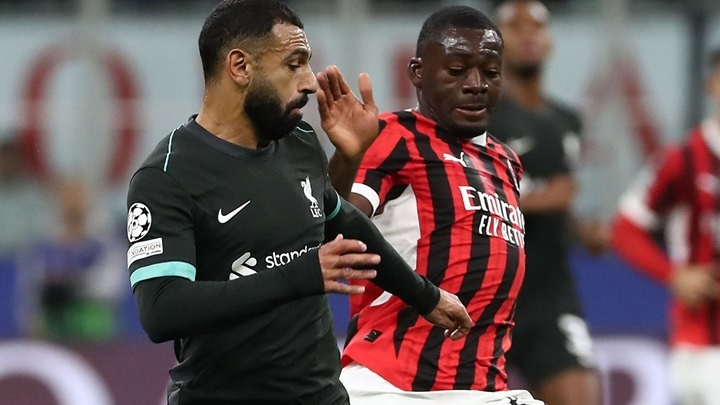
When it comes to European football, few fixtures evoke the same level of excitement and nostalgia as a match between AC Milan and Liverpool FC. These two clubs boast rich histories in the sport, with their respective legacies etched in the annals of the UEFA Champions League. Their encounters, particularly in the grandest stage of European football, have produced some of the most memorable moments in the competition’s history.
A Brief History of AC Milan and Liverpool FC
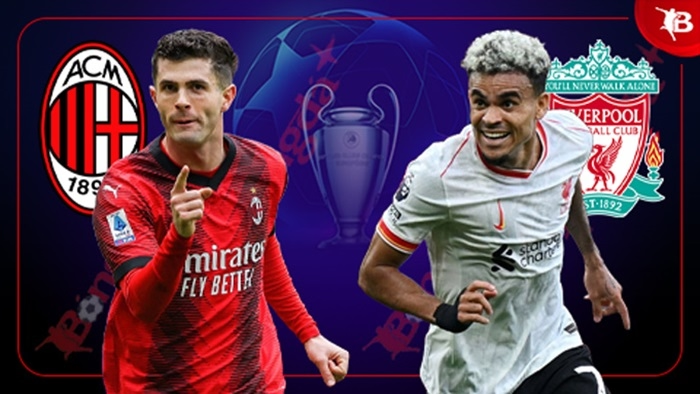
AC Milan: A Powerhouse of Italian Football
Founded in 1899, AC Milan is one of Italy’s most successful clubs, known for its rich footballing tradition and flair for nurturing talent. Milan has dominated both domestically and in Europe, with seven Champions League titles to their name, making them the second-most successful club in the competition, after Real Madrid. Their golden era of the late 1980s and early 1990s under the stewardship of managers like Arrigo Sacchi and Fabio Capello cemented their reputation as a tactical and technical masterclass in European football.
With legendary players like Franco Baresi, Paolo Maldini, Kaka, and Andrea Pirlo, Milan has created a legacy of high-caliber football, built on discipline, technique, and tactical intelligence.
Liverpool FC: England’s European Kings
Liverpool FC, founded in 1892, has an equally illustrious history, with six Champions League titles, the most by any English club. From Bill Shankly’s revolutionary period in the 1960s to the recent successes under Jürgen Klopp, Liverpool has enjoyed periods of domestic and European dominance.
Players like Kenny Dalglish, Steven Gerrard, and Mohamed Salah have defined different eras at the club, each contributing to Liverpool’s status as a global footballing institution. The iconic “You’ll Never Walk Alone” anthem and the passionate atmosphere at Anfield make Liverpool a club with a soul deeply connected to its fans.
Iconic Clashes: The Champions League Finals of 2005 and 2007
The Milan vs. Liverpool rivalry reached its pinnacle in the mid-2000s with two unforgettable Champions League finals—one in Istanbul in 2005 and the other in Athens in 2007. Both matches are remembered for different reasons, but they cemented the Milan-Liverpool rivalry in football folklore.
The Miracle of Istanbul – 2005 Champions League Final
The 2005 final is often described as one of the greatest football matches of all time. Played in Istanbul, the game saw AC Milan take a commanding 3-0 lead at half-time, with goals from Paolo Maldini and a brace from Hernán Crespo. Milan was dominant in every aspect, and by the end of the first half, many had written Liverpool off.
However, the second half produced one of the most remarkable comebacks in football history. In just six minutes, Liverpool clawed back from 3-0 down to 3-3, with goals from Steven Gerrard, Vladimir Smicer, and Xabi Alonso. The match went to extra time, and then penalties, where Liverpool goalkeeper Jerzy Dudek made two critical saves, handing Liverpool a stunning victory and their fifth Champions League title.
The 2005 final is often called “The Miracle of Istanbul,” a testament to Liverpool’s resilience and ability to thrive under immense pressure. For Milan, the defeat was devastating, despite their dominant performance in the first half. However, they would have their chance for revenge two years later.
Also Read: Fall Brunch Ideas
Revenge in Athens – 2007 Champions League Final
In 2007, AC Milan and Liverpool met again, this time in the Champions League final in Athens. Milan, eager to avenge their loss in 2005, entered the match with a clear tactical plan. This time, it was the Italians who triumphed, with Filippo Inzaghi scoring twice to give Milan a 2-1 victory. While Dirk Kuyt scored a late goal for Liverpool, it wasn’t enough to mount another comeback.
For Milan, the win in 2007 was redemption. Players like Paolo Maldini and Andrea Pirlo were determined to erase the pain of 2005, and they succeeded with a disciplined and controlled performance. The 2007 final may not have had the same drama as 2005, but it was a tactical masterclass by Carlo Ancelotti’s Milan.
Tactical Battles: Contrasting Styles of Play
One of the most fascinating aspects of Milan vs. Liverpool encounters is the contrast in playing styles. Traditionally, Milan has been known for their tactical discipline, defensive solidity, and reliance on moments of brilliance from their attacking players. In contrast, Liverpool, particularly under Klopp, have emphasized high-energy, pressing football with a focus on counter-attacking and quick transitions.
Milan’s Tactical Rigor
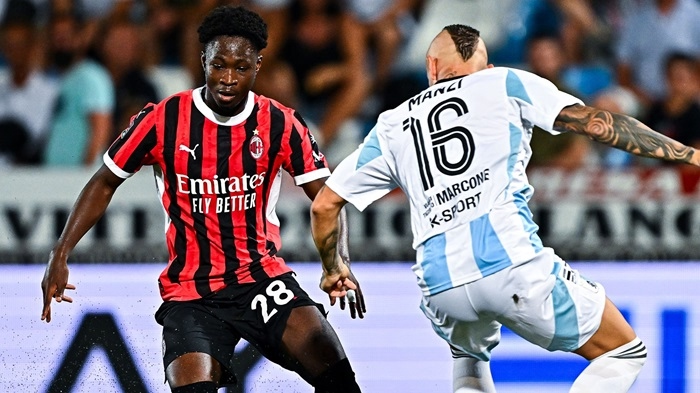
Milan’s football has often been synonymous with tactical sophistication. Whether under Sacchi’s aggressive pressing system or Ancelotti’s more balanced and flexible 4-4-2 diamond, Milan teams have been built on a solid defensive foundation. Players like Maldini, Alessandro Nesta, and Franco Baresi were not just excellent defenders; they were leaders who could read the game and organize the backline impeccably.
In attack, Milan has historically relied on the creativity of players like Kaka and Pirlo to unlock defenses. Inzaghi, known for his positioning and predatory instincts in the box, was a key figure in Milan’s victories over Liverpool.
Liverpool’s High-Pressing Philosophy
In contrast, Liverpool’s modern success, especially under Jürgen Klopp, has been built on a philosophy of “gegenpressing,” a high-octane system that aims to win the ball high up the pitch and transition quickly into attack. Klopp’s Liverpool has been defined by its front three of Mohamed Salah, Sadio Mane, and Roberto Firmino, who have terrorized defenses with their pace, movement, and finishing ability.
While Liverpool has also been solid defensively, particularly with Virgil van Dijk marshalling the backline, their attacking style has been their most distinguishing feature. Their ability to press high and overload opponents in wide areas has often caught more tactically rigid teams off-guard.
Cultural and Historical Significance
The cultural and historical significance of Milan vs. Liverpool extends beyond the pitch. Both clubs represent cities with deep working-class roots, and both have fanbases that are incredibly passionate and proud of their footballing traditions.
AC Milan and the Italian Legacy
Milan’s success in Europe has always been a source of pride for Italian football. The club represents the elegance and tactical superiority often associated with Italian football. The “Rossoneri” (Red and Blacks) have always embodied the traditional values of Italian football: pragmatism, defensive solidity, and technical prowess.
Milan’s success in the Champions League has been seen as a triumph for Italian football on the global stage, particularly during the late 1980s and early 1990s, when Serie A was considered the best league in the world.
Liverpool and the Spirit of Anfield
Liverpool’s success in Europe, particularly their five Champions League titles before 2005, has made them one of the most decorated clubs in England. The emotional connection between the club and its supporters is one of the strongest in football, with Anfield known for producing some of the most electric atmospheres in European competitions.
The city of Liverpool, with its rich musical and cultural history, has always had a close relationship with the club. The famous “You’ll Never Walk Alone” anthem, sung by thousands of fans at every match, epitomizes the unity and spirit that defines Liverpool as a club.
The Milan vs. Liverpool rivalry may not be as frequent as some other European matchups, but every time these two giants meet, it is a spectacle that captures the essence of football. Their iconic Champions League finals in 2005 and 2007 will forever be remembered as two of the most dramatic moments in European football history.
As both clubs continue to evolve, their encounters remain a reminder of their storied pasts and their enduring status as European football powerhouses. Fans of both clubs eagerly await the next chapter in this captivating rivalry, knowing that every Milan vs. Liverpool match has the potential to create new memories that will last a lifetime.