

Real Madrid Club de Fútbol, often simply referred to as Real Madrid, is not just one of the most successful football clubs in history, but also a symbol of excellence, prestige, and global dominance in the sport. Known for their iconic all-white kits and boasting a roster of some of the greatest players in football history, Real Madrid has consistently been at the forefront of European and world football for over a century. This post delves into the history, legacy, and continued dominance of Real Madrid, exploring the club’s key moments, legendary players, and its significance in both Spanish and international football.
The Founding of Real Madrid
Real Madrid was officially founded on March 6, 1902, by a group of football enthusiasts in Madrid, Spain. Initially named Madrid Football Club, the team’s early years were spent establishing itself in Spanish football. In 1920, King Alfonso XIII granted the club the title “Real,” meaning “royal” in Spanish, and the club adopted the name Real Madrid.
The club’s early dominance in Spanish football began in the 1930s when it won its first La Liga title. However, it was after the Spanish Civil War that Real Madrid’s footballing prowess truly began to take shape. The club’s focus on success at both the domestic and European levels would soon see it become a global force.
The Di Stéfano Era: The Birth of European Supremacy
One of the most defining periods in Real Madrid’s history came in the 1950s, with the arrival of Argentine forward Alfredo Di Stéfano. Di Stéfano’s impact on Real Madrid cannot be overstated. His ability to score goals, create chances, and control the tempo of games elevated the club to new heights.
With Di Stéfano leading the charge, Real Madrid dominated European football. Between 1956 and 1960, the club won five consecutive European Cup titles (the precursor to today’s UEFA Champions League), solidifying their status as the kings of European football. Di Stéfano, alongside legendary players like Ferenc Puskás and Francisco Gento, became the foundation of Real Madrid’s legacy as the most successful club in European history.
These victories not only established Real Madrid as a dominant force but also introduced the world to the notion of the “Galácticos,” a philosophy of assembling the best talent in the world, a principle that would resurface in later decades.
Domestic Dominance: La Liga Success
Real Madrid’s domestic success is as impressive as their European feats. With 35 La Liga titles (as of 2024), they have won more Spanish league championships than any other club. Their dominance in La Liga has been characterized by periods of total supremacy, often in direct competition with archrival FC Barcelona.
Throughout the decades, Real Madrid has been able to maintain their dominance thanks to their ability to continuously attract and develop world-class talent. From the 1970s team, which included players like Pirri and Amancio, to the 1980s Quinta del Buitre generation, led by Emilio Butragueño, Real Madrid’s success has always been built on a foundation of homegrown talent combined with marquee signings.
The Galáctico Era: A New Age of Superstars
In the early 2000s, under the presidency of Florentino Pérez, Real Madrid embarked on a new era that would further elevate the club’s profile globally—the Galáctico era. Pérez’s strategy was simple: sign the best players in the world, regardless of cost. During this period, Real Madrid signed legendary figures like Luís Figo, Zinedine Zidane, Ronaldo Nazário, and David Beckham, creating a team packed with global superstars.
This approach transformed Real Madrid into the world’s most glamorous football club, blending success on the pitch with massive commercial growth. The team’s crowning achievement during this period was their 2002 UEFA Champions League victory, where Zinedine Zidane scored one of the most iconic goals in football history, a stunning volley in the final against Bayer Leverkusen.
While the Galáctico project brought success and fame, it also faced criticism for its imbalance between star players and team cohesion. However, Pérez’s vision undeniably positioned Real Madrid as a global sports brand like no other.
Also Read: Juventus vs PSV: A European Rivalry
The Champions League Dynasty: Modern Success
Real Madrid’s dominance in the modern era is perhaps best exemplified by their extraordinary success in the UEFA Champions League. Between 2014 and 2018, Real Madrid won the Champions League four times in five years, a feat unprecedented in the modern game.
Led by manager Zinedine Zidane, who had returned to the club in a managerial capacity, and with Cristiano Ronaldo at his peak, Real Madrid cemented their status as Europe’s most successful club. The 2016, 2017, and 2018 victories were particularly notable, as Real Madrid became the first team to win the Champions League three times in a row since Bayern Munich in the 1970s.
Cristiano Ronaldo, the club’s all-time leading scorer, was the face of this success, scoring vital goals in key moments and breaking numerous records along the way. Under Zidane’s leadership, the team displayed a mix of tactical flexibility, individual brilliance, and an unbreakable winning mentality.
Legendary Players of Real Madrid
Real Madrid’s history is closely tied to some of the greatest players ever to grace the football pitch. The list of legendary players who have worn the famous white shirt is long and illustrious, but a few stand out above the rest.
Alfredo Di Stéfano: As previously mentioned, Di Stéfano is considered one of the greatest players in football history. His arrival in the 1950s transformed Real Madrid into a European powerhouse, and his influence on the club is still felt today.
Cristiano Ronaldo: Signed from Manchester United in 2009, Ronaldo quickly became the club’s talisman. During his nine-year tenure, Ronaldo scored over 450 goals and led Real Madrid to four Champions League titles, becoming the club’s all-time leading scorer and one of the best players in history.
Raúl González: A symbol of loyalty and leadership, Raúl spent 16 years at Real Madrid, becoming the club’s second-highest goal scorer and an embodiment of the club’s values on and off the pitch.
Zinedine Zidane: As both a player and a manager, Zidane’s impact on Real Madrid is monumental. His elegance on the field, epitomized by his famous Champions League-winning goal in 2002, is matched by his success as a manager, guiding the club to three consecutive Champions League titles.
Iker Casillas: Widely regarded as one of the best goalkeepers of all time, Casillas was a product of Real Madrid’s youth academy and spent 25 years at the club, winning five La Liga titles and three Champions League titles.
Rivalries: The El Clásico and Beyond
One cannot talk about Real Madrid without mentioning their fierce rivalry with FC Barcelona, known as El Clásico. This is more than just a football match—it is a cultural, political, and sporting spectacle that captivates millions of fans around the world. The rivalry between these two clubs is rooted in the historic regional tensions between Madrid and Catalonia, but on the field, it’s a battle between two of the biggest football clubs in the world.
Throughout history, El Clásico has produced iconic moments, legendary performances, and intense drama. Whether it’s Lionel Messi and Cristiano Ronaldo dueling at the height of their powers, or controversial refereeing decisions, the fixture never fails to deliver. Beyond Barcelona, Real Madrid also shares significant rivalries with Atlético Madrid (the Madrid Derby) and other major European clubs such as Bayern Munich and Juventus.
Real Madrid’s Impact on Global Football
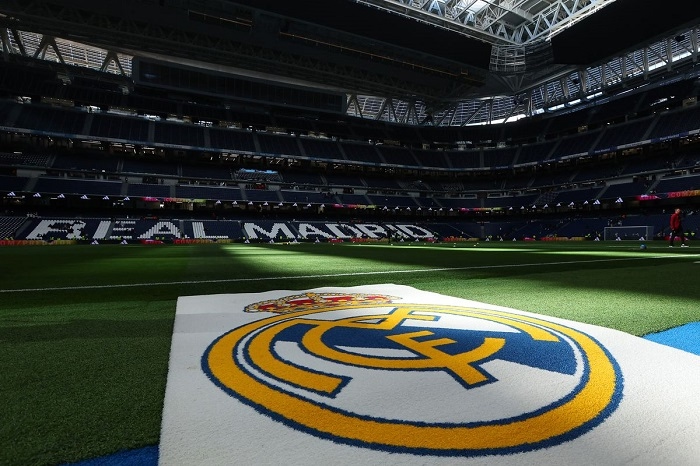
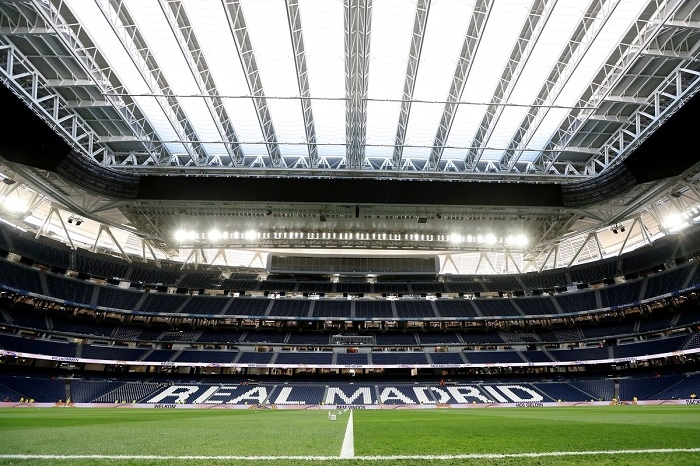
Real Madrid’s influence extends beyond just their success on the field. As one of the wealthiest and most popular clubs globally, Real Madrid has set standards for modern football in terms of marketing, branding, and international expansion. Their famous stadium, the Santiago Bernabéu, is not just a fortress for home games but also a global symbol of football excellence.
The club’s commitment to signing the best players, developing homegrown talent through its famed La Fábrica academy, and their extensive network of global partnerships have solidified their place as a cultural institution as much as a football club.
Real Madrid Today: Continuity and Evolution
As of 2024, Real Madrid continues to evolve, adapting to the changing landscape of modern football while maintaining its traditional values of excellence and success. Under the leadership of President Florentino Pérez and a new generation of stars like Vinícius Júnior, Rodrygo, and Eduardo Camavinga, Real Madrid remains one of the most competitive teams in both La Liga and the Champions League.
The club’s focus on developing young talent while maintaining a high standard of global recruitment suggests that their dominance will continue well into the future. Real Madrid’s global fanbase continues to grow, and their success on the field is matched by their ability to remain at the forefront of football innovation and business.
Real Madrid is more than just a football club; it is an institution that has transcended the sport itself. With a history of unprecedented success, legendary players, and a global fanbase, Real Madrid stands as a symbol of footballing excellence. Whether through their domination of the Champions League or their iconic rivalries, Real Madrid’s legacy is firmly entrenched as the kings of European football. As they continue to evolve and compete at the highest levels, Real Madrid’s future looks as bright as their storied past.