

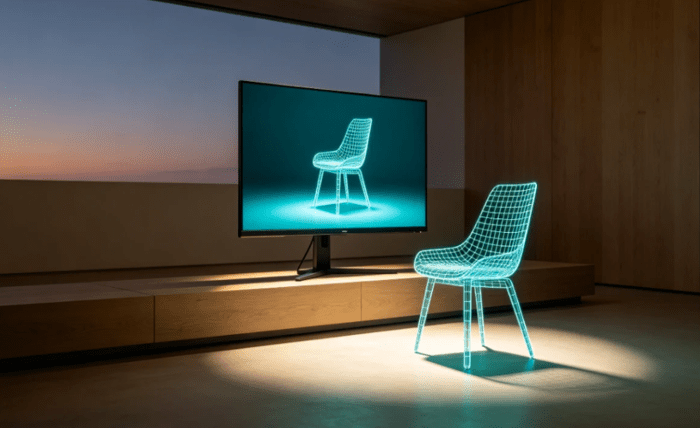
The frustration of traditional interior design often lies in the friction between a creative vision and the tools used to realize it. Most software suites are a bloated mess of features that prioritize technical complexity over spatial clarity. When the goal is to create a calm, coordinated room, spending days pushing vertices or fixing broken UV maps is counter-productive. A minimalist approach to spatial planning requires efficient 3D design software that strips away the noise, allowing you to move from a single reference photo to a functional asset in seconds.
Stripping Away the “Digital Noise”
Traditional 3D modeling is often plagued by “technical debt”—disorganized meshes and non-manifold edges that complicate the rendering process. In a high-performance design workflow, these errors are the opposite of minimalism. By focusing on the essence of geometry, the Direct3D-S2 engine ensures that every generated model is watertight and immediately ready for use.
This efficiency is powered by the spatial sparse attention mechanism. By optimizing how the AI processes volumetric data, the system significantly reduces computational overhead, ensuring that high-fidelity mesh generation does not require a brute-force approach to hardware.
Consistency Through Native Volumetric Logic
Design consistency fails when a tool relies on surface-level “guesses.” If an algorithm only sees a flat front-facing profile, it often guesses the depth incorrectly, leading to distorted models. To achieve true visual harmony, Native volumetric logic is essential. It processes the full volume of an object, ensuring the geometry remains mathematically sound from every angle.
🎯 The Essence of Technical Clarity:
⚡ Pure Albedo Textures: By removing “dead shadows” and baked-in lighting, assets react naturally to the specific light sources in your coordinated space.
⚡ Quad-Dominant Topology: Clean edge flow ensures that models are lightweight and responsive in real-time web viewers or AR environments.
⚡ Deterministic Output: The system provides reliable results that strictly adhere to your prompts, eliminating the “slot-machine” randomness of lesser models.
A Systematic Reboot for Creative Professionals
An intentional design process should be a “systematic reboot” of your creative habits. Instead of fighting a blank canvas, you start with a solid, engine-ready foundation. This workflow allows you to upload a reference of a bespoke furniture piece and receive a professional mesh with native Normal, Roughness, and Metallic maps already calculated.
✅ A Streamlined Design Pipeline:
⚡ Direct Capture: Use a 3/4 view photo to provide the system with the best reference points for volume calculation.
⚡ Instant Reconstruction: Generate the base mesh in seconds, bypassing hours of manual topology work.
⚡ Seamless Integration: Export directly to .fbx or .glb formats to drop assets into your coordinated digital twin without intermediate conversion steps.
Elevating the Essence of Design
True minimalism in tools leads to better intentionality in results. When you eliminate the technical friction of 3D production, you reclaim the time needed to focus on the textures, colors, and balance of a space. By prioritizing a toolset that values pipeline integration and geometric purity, you ensure that your design remains focused on its essence: creating a functional, beautiful, and coordinated environment.