

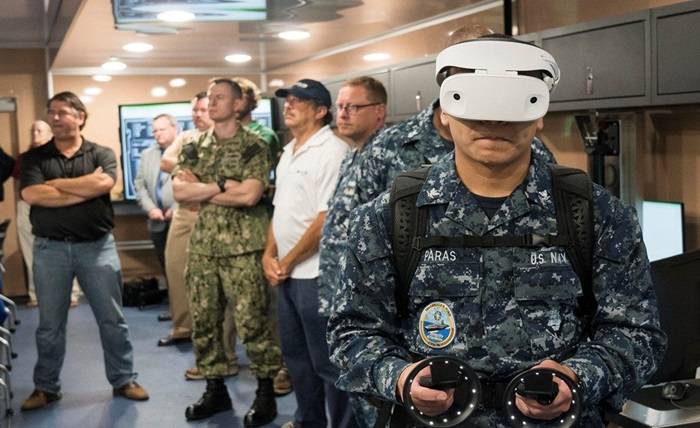
In the realm of modern warfare, where technology continuously evolves, military forces worldwide are harnessing the power of Virtual Reality (VR) to revolutionise training and operations. VR, once primarily associated with gaming and entertainment, has now found a profound application in military training, offering immersive and realistic simulations that enhance readiness, decision-making, and overall effectiveness on the battlefield.
One of the primary advantages of Military VR lies in its ability to simulate a wide array of combat scenarios in a controlled environment. Soldiers can undergo training in diverse terrains, from urban settings to dense forests, without physically being there. This versatility enables troops to adapt to various environments and scenarios, preparing them for the unpredictability of real-world combat situations.
Moreover, VR provides a safe space for trainees to make mistakes and learn from them without risking injury or damage to equipment. By replicating realistic combat scenarios, soldiers can practice tactical manoeuvres, weapon handling, and teamwork in a risk-free environment. This iterative process allows for continuous improvement and skill enhancement, ultimately enhancing combat readiness.
Furthermore, Military VR facilitates collective training exercises, allowing soldiers from different locations to train together in virtual environments. This collaborative approach fosters teamwork and communication among units, regardless of their geographical dispersion. By training together virtually, troops can develop cohesion and coordination crucial for successful mission execution.
Beyond training applications, Military VR is also proving to be a valuable tool for mission planning and rehearsal. Commanders can use VR simulations to visualise mission objectives, terrain, and potential threats, enabling them to formulate strategies and tactics more effectively. Additionally, troops can conduct virtual rehearsals of complex operations, refining their approach and minimising the margin for error before executing missions in the field.
In the realm of intelligence, surveillance, and reconnaissance (ISR), VR technologies offer new avenues for data visualisation and analysis. Analysts can immerse themselves in virtual environments constructed from satellite imagery, drone footage, and other sources of intelligence, gaining deeper insights into enemy movements and terrain features. This enhanced situational awareness enables commanders to make informed decisions swiftly, giving their forces a competitive edge on the battlefield.
Moreover, Military VR has the potential to revolutionise post-mission debriefings and after-action reviews (AARs). By recording and replaying VR simulations of missions, soldiers can retrospectively analyse their performance, identify areas for improvement, and extract valuable lessons learned. This reflective process is invaluable for refining tactics, techniques, and procedures, ultimately enhancing overall operational effectiveness.
However, while the potential benefits of Military VR are substantial, challenges remain in its widespread adoption and integration. Technical constraints, such as latency issues and hardware limitations, need to be addressed to ensure seamless and realistic simulation experiences. Moreover, the cost of developing and maintaining VR training systems may present a barrier to entry for some military organizations.
In conclusion, Military VR represents a paradigm shift in how armed forces approach training, operations, and decision-making. By leveraging immersive simulations, soldiers can enhance their skills, teamwork, and situational awareness in a risk-free environment. As technology continues to advance, the integration of VR into military training and operations will likely become increasingly prevalent, shaping the future of warfare in profound ways. For more information visit ST Engineering Antycip