


Dwight Howard, a name synonymous with dominance on the basketball court, has carved a unique legacy in the NBA. Known for his athleticism, defensive prowess, and larger-than-life personality, Howard’s career has seen incredible highs and challenging lows. From his early days as a high school phenom to his reign as one of the NBA’s premier centers and his eventual resurgence as a key role player, Howard’s journey through the league has been nothing short of eventful. In this comprehensive look at Dwight Howard’s life and career, we explore the many facets of this eight-time All-Star, three-time Defensive Player of the Year, and NBA champion.
Early Life and Path to Stardom

Born on December 8, 1985, in Atlanta, Georgia, Dwight David Howard Jr. grew up in a family with a strong connection to athletics. His father was the athletic director at Southwest Atlanta Christian Academy, where Dwight would attend school and develop his skills on the basketball court. From an early age, Howard’s physical gifts were apparent—he was tall, agile, and incredibly coordinated for his size.
By the time he reached high school, Howard had already begun to make a name for himself as one of the most dominant players in the country. At Southwest Atlanta Christian Academy, Howard led his team to a state championship in 2004, averaging an astounding 25 points, 18 rebounds, and 8.1 blocks per game during his senior year. His dominance on the court caught the attention of NBA scouts, and soon, Howard was being hailed as the next great big man.
Entering the NBA: The Number One Draft Pick
In 2004, Dwight Howard made the decision to forgo college and declare for the NBA Draft. At just 18 years old, he was selected as the first overall pick by the Orlando Magic. The expectations were sky-high for Howard, and he wasted no time making an impact in the league. Despite his youth, he was immediately thrust into the role of a franchise cornerstone for the Magic.
In his rookie season, Howard showed flashes of brilliance, averaging 12 points and 10 rebounds per game. More importantly, he quickly established himself as a defensive force, using his athleticism and size to alter shots and dominate the paint. Over the next few years, Howard’s game would continue to evolve as he refined his offensive skills, including his post moves and his ability to finish around the basket.
The Rise of Superman: Dominance in Orlando
By his third season in the NBA, Dwight Howard had blossomed into a full-fledged superstar. His combination of size, speed, and athleticism made him a nightmare matchup for opposing teams. Howard’s presence in the paint was unparalleled, and he led the NBA in rebounds and blocked shots for multiple seasons. He earned the nickname “Superman” for his incredible leaping ability and powerful dunks that wowed fans and opponents alike.
From 2007 to 2012, Howard was widely considered the best center in the league. He led the Magic to the NBA Finals in 2009, where they fell short to the Los Angeles Lakers. Nevertheless, Howard’s performance in the playoffs cemented his status as one of the most dominant forces in basketball. He was named Defensive Player of the Year three times (2009, 2010, and 2011), further solidifying his legacy as one of the greatest defenders in NBA history.
Defensive Prowess: A Three-Time Defensive Player of the Year
Howard’s defensive accolades were well-deserved. During his peak, he was not only a rim protector but also an elite rebounder. Howard led the league in rebounds five times and in blocks twice. His ability to anchor a defense made him the focal point of Orlando’s strategy, allowing his team to build around his defensive presence.
His back-to-back-to-back Defensive Player of the Year awards from 2009 to 2011 placed him in elite company, joining legends like Dikembe Mutombo and Ben Wallace as the only players to win the award three or more times. His shot-blocking, rebounding, and ability to guard the paint were unmatched during his prime, making him a game-changer on the defensive end.
Also Read: Billie Eilish
The Magic Breakup and Howard’s NBA Journeyman Phase
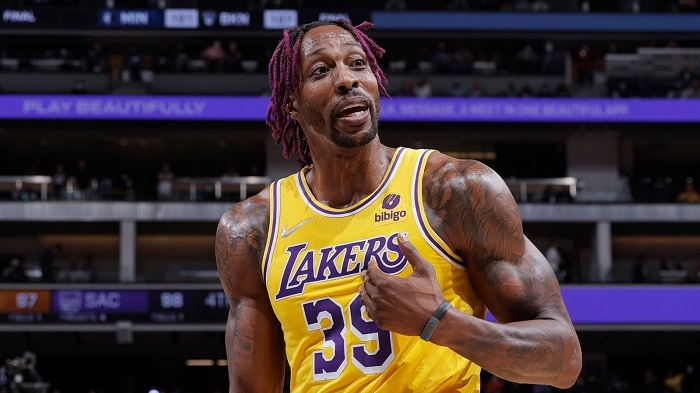
After several successful seasons in Orlando, Howard’s relationship with the Magic began to deteriorate. Rumors of friction between Howard and then-head coach Stan Van Gundy, as well as the front office, created a tense atmosphere. In 2012, Howard requested a trade, leading to a blockbuster deal that sent him to the Los Angeles Lakers, where he joined Kobe Bryant and Steve Nash in hopes of forming a championship contender.
However, things did not go as planned in Los Angeles. Howard struggled to fit into the Lakers’ system, and injuries hampered his ability to perform at the level he had in Orlando. The Lakers were eliminated in the first round of the playoffs, and Howard’s lone season in Los Angeles was viewed as a disappointment.
After leaving the Lakers, Howard embarked on a journeyman phase of his career, with stops in Houston, Atlanta, Charlotte, and Washington. While he still put up solid numbers during these years, injuries and changing roles caused his impact to wane. He was no longer the dominant force he once was, and many began to question whether Howard’s best days were behind him.
Resurgence with the Lakers: The Championship Journey
In 2019, Howard’s career came full circle when he rejoined the Los Angeles Lakers, this time with far different expectations. No longer the dominant superstar, Howard accepted a reduced role, focusing on defense, rebounding, and providing energy off the bench. This new chapter in his career saw a more mature and selfless version of Dwight Howard.
Howard’s contributions were critical to the Lakers’ success during the 2019-2020 season, helping the team secure the best record in the Western Conference. His ability to defend the rim and bring toughness to the frontcourt were key assets, especially during the Lakers’ playoff run in the NBA bubble.
In October 2020, Howard achieved the ultimate goal that had eluded him for so long: winning an NBA championship. The Lakers defeated the Miami Heat in the Finals, and while LeBron James and Anthony Davis were the stars, Howard’s role as a veteran leader and defensive anchor was undeniable. The championship was a crowning achievement in Howard’s long and illustrious career, cementing his place in NBA history.
Howard’s Impact on the Game: A Hall of Fame Career?
Throughout his career, Dwight Howard has accumulated numerous accolades: eight All-Star selections, five All-NBA First Team nods, and a championship ring. His numbers—over 19,000 points, 14,000 rebounds, and 2,000 blocks—place him among the greatest centers in NBA history. Despite the ups and downs, Howard’s contributions to the game have been immense, both statistically and culturally.
The question of whether Dwight Howard will be inducted into the Hall of Fame is frequently debated, but his resume is undoubtedly worthy. His dominance during his prime, combined with his longevity and ability to adapt to different roles, makes him one of the most impactful players of his generation.
Beyond Basketball: Personal Life and Philanthropy

Off the court, Dwight Howard has been known for his charitable efforts and commitment to giving back. His Dwight D. Howard Foundation provides scholarships for students and supports various educational programs. Howard has also been involved in numerous community service initiatives, including promoting healthy lifestyles and supporting underprivileged children.
In addition to his philanthropy, Howard has a love for entertainment. He’s made appearances in television shows and films, and his larger-than-life personality has made him a popular figure in pop culture.
Dwight Howard’s journey through the NBA is one of triumph, perseverance, and reinvention. From his days as a high-flying phenom in Orlando to his championship moment with the Lakers, Howard has left an indelible mark on the game of basketball. His dominance as a defender and rebounder, combined with his charismatic personality, has made him one of the most memorable figures in recent NBA history.
As Howard continues to play and contribute to the game in his later years, his legacy is still being written. Whether as a future Hall of Famer or as an ambassador for the game, Dwight Howard’s impact on basketball will be felt for generations to come.