


Artificial Intelligence, or AI, has emerged as a powerful companion in the world of product development. From speeding up research to automating routine tasks, AI is making product building smarter, faster, and more accurate than ever before.
According to recent market reports, the global AI in product development market is expected to experience significant growth over the next few years. Experts have predicted it could reach up to $20 billion by 2030. This trend shows that AI is here to stay and evolve, especially in industries like eCommerce, healthcare, finance, and software development.
But these company owners, especially those new to the market, often struggle to understand how AI in product development works. What key use cases does it hold, and what benefits could they get? To help them understand, we have created this blog post that includes all the key information.
How does AI in Product Development Work?
AI in product development works like a digital assistant that helps you build better products faster. Let’s explore its work cycle step by step to better understand:
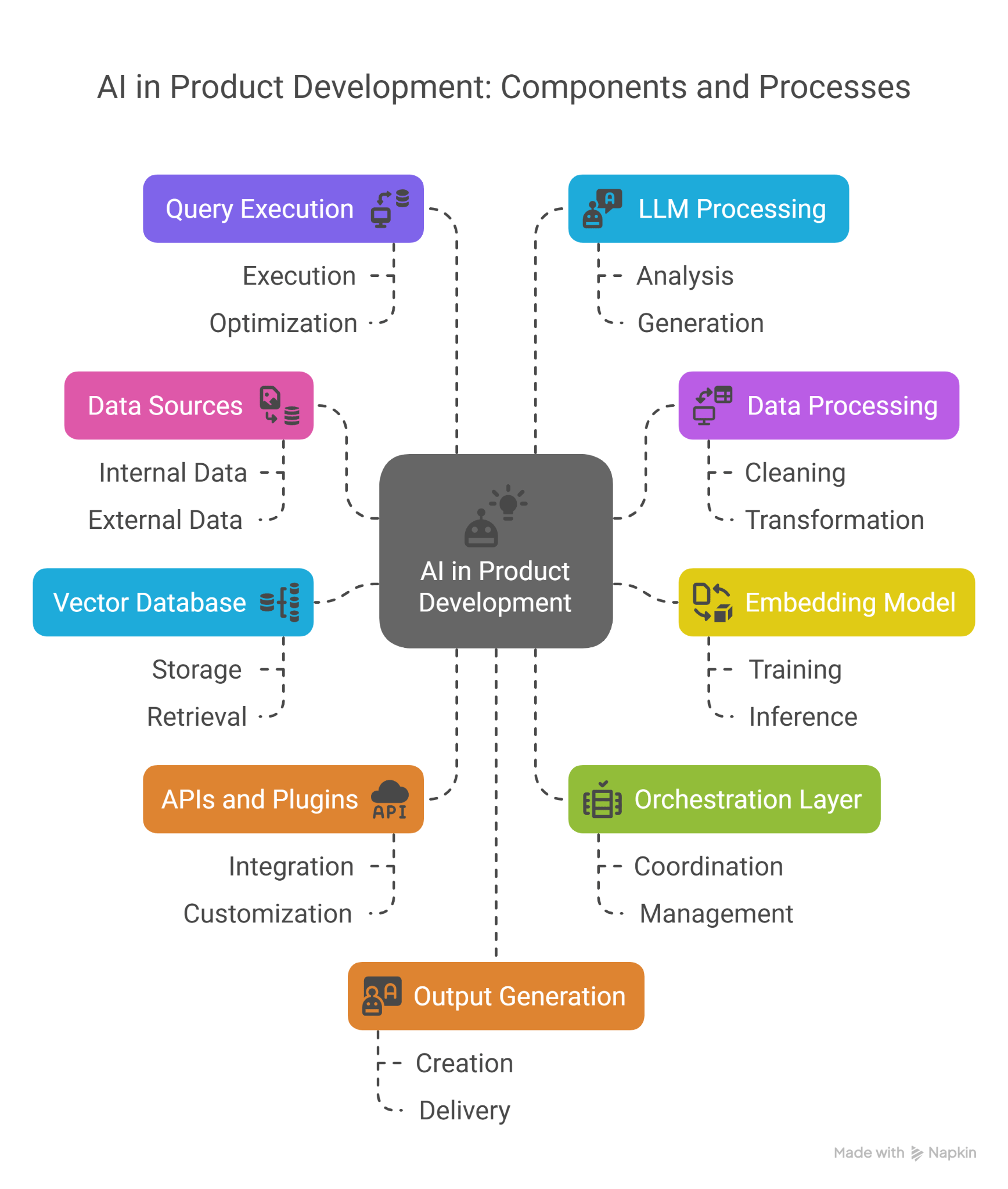
Data Sources: AI starts by collecting data in the form of customer reviews, sales numbers, product usage data, or even market trends from different sources.
Data Processing: Once the data is collected, AI begins identifying patterns and sorting information to be used in innovative ways.
Embedding Model: This step turns the data into a form that AI can understand. These models help the AI make sense of words, numbers, and even emotions in the data.
Vector Database: AI uses vector databases to store and search data quickly. These databases are super fast and allow AI to retrieve similar patterns or results almost instantly.
APIs and Plugins: Application Programming Interfaces and plugins allow different software systems to communicate. This means your AI tool can seamlessly integrate with your design software, CRM, or testing tool, eliminating the need for manual effort.
Orchestration Layer: This layer controls the interaction between the various components of the AI system. It ensures every instrument plays at the right time.
Query Execution: Once everything is set up, you can ask the AI questions or request certain tasks, such as generating a product idea or analyzing user feedback.
LLM Processing: Large Language Models (LLMs) such as ChatGPT or Google Gemini read the data and generate smart, human-like responses.
Output Generation: After the AI processes the query, it gives you the output. This could be a product mockup, customer insights, a content suggestion, or a test result.
Product Development App: All of these steps are usually managed through a dedicated product development tool or app. This app brings together your team and AI in one place, making collaboration easy and organized.
Feedback Loop: AI gets smarter over time by learning from past data and outputs. Each time it receives feedback (good or bad), it uses that feedback to improve future responses and results.
Agents: These are like mini-AIs that handle specific tasks, such as design, testing, and customer feedback, among others. You can assign agents to different jobs to speed things up and reduce manual errors.
LLM Cache: To save time and cost, AI stores the answers to common or repeated queries. So, next time you ask the same thing, it responds instantly without starting from scratch.
Logging and LLMOps: If something goes wrong, logs help you find out what happened. LLMOps (Language Model Operations) ensure everything runs safely and smoothly.
Validation: Before using AI-generated results, you want to make sure they’re right. This step checks the accuracy of the output. It’s like proofreading before publishing.
LLM APIs and Hosting: Finally, the AI system is hosted online or on your servers. APIs connect everything together and allow your AI solution to function 24/7, anywhere in the world.
Key Use Cases of AI In Product Development
AI is reshaping how products are built, from brainstorming ideas to launching them in the market. Let’s look at some real-world AI use cases in product development:
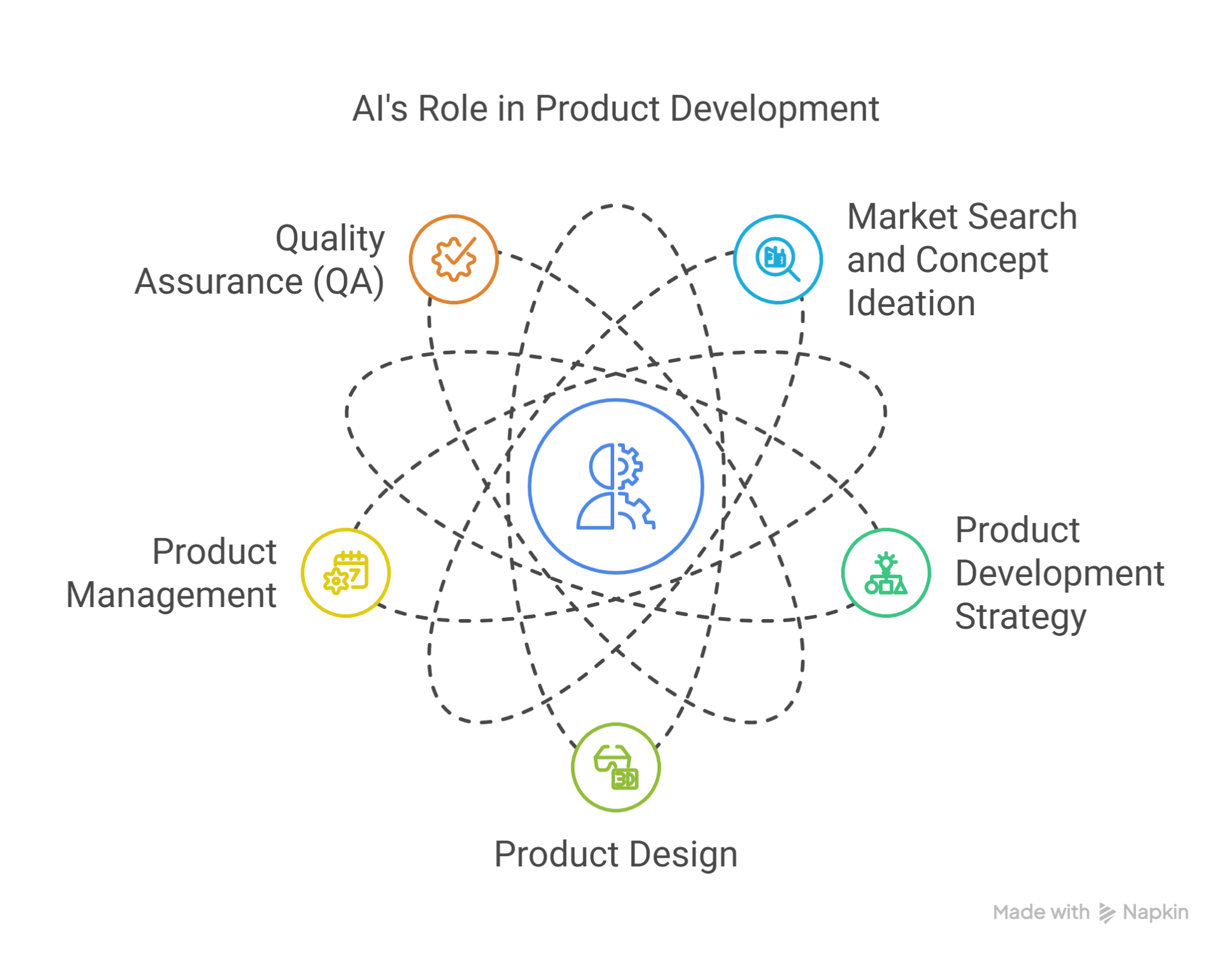
Market Search and Concept Ideation
AI can analyze search trends, customer behavior, and competitor products to help you find product gaps and new opportunities.
Netflix uses AI to recommend content and even guide the production of shows based on viewing data, which is one of the best real-world examples of AI in product development.
Product Development Strategy
AI helps businesses build solid product strategies by evaluating risks, forecasting success, and setting realistic timelines. It also assists in deciding which features to prioritize for maximum impact.
Product Design
AI tools can automatically generate design wireframes, suggest UI/UX improvements, and even personalize designs for different user types. This saves designers time and leads to a more user-friendly product.
Product Management
Project managers use AI-powered dashboards to track tasks, team progress, and deadlines. The AI helps highlight roadblocks and suggests fixes, improving overall coordination.
Quality Assurance (QA)
AI automates product testing, catching bugs faster and more efficiently than manual testers. It also keeps testing, which helps launch products with fewer errors.
How Can You Integrate AI into Your Product Development Process?
Adopting AI doesn’t need to be complex. But we still suggest partnering with a trusted AI development company in India, which will make things easier. Here’s a simplified roadmap:
- Identify Objectives: Start by defining your goals. Whether you want to speed up product launches, reduce errors, or improve customer feedback loops, a clear goal will guide your AI setup.
- Begin Market Research: Use AI tools to scan the market and understand what your users need, how competitors are performing, and where there’s a demand-supply gap.
- Choose the Right AI Model: Not every AI model fits every business. Some are great for customer service, and others excel in automation. Pick what best suits your industry and product lifecycle.
- Outsource Professional Team: If you lack in-house expertise, it’s smart to hire AI developersfrom a reliable source. This ensures high-quality work without the cost of full-time hiring.
- System Integration: Make sure your AI tool can connect with your existing systems, such as CRMs, design tools, or QA platforms, so everything flows together without any issue.
Benefits of AI in Product Development
Integrating AI into product development doesn’t just improve how you build products; it transforms the entire experience:
- Enhanced Efficiency: AI reduces the need for manual tasks, letting your team focus on strategy and creativity. Things get done faster and with less human error.
- Data-driven Decision Making: AI turns raw data into actionable insights so that every move you make is backed by real facts.
- Personalized Customer Experience: AI can segment your audience and tailor product features or messages for each group. This creates a user experience that feels personal and engaging.
- Improved Product Quality: With continuous feedback and smart testing, AI ensures your product is polished, functional, and ready for users.
- Reduced Cost: AI automates time-consuming jobs, which means fewer resources are needed, and costs go down over time.
End Note
AI is quickly becoming a powerful ally in many businesses’ product development. From brainstorming ideas and designing features to testing products and improving user experience, AI adds value at every step of the journey.
Whether you’re a startup exploring your first product or an established business aiming to scale, integrating AI into your process can lead to better decisions, faster results, and stronger connections with your users.
Discover the ideal AI and ML development services for your product development workflow and transform your business dynamics!