

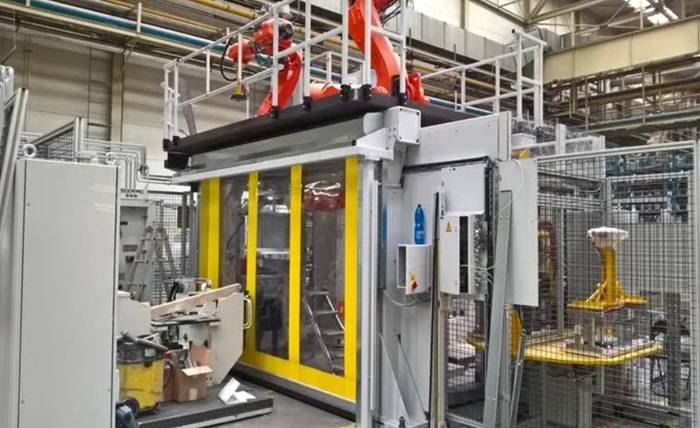
The robotic cell is a controlled and defined area or a self-contained workspace that is specifically built around robots in an industrial facility. This is where one or more robots are created to perform specific automated tasks. The robotic cells include the machinery, sensors, robots, tools, safety systems, and material handling equipment that are imperative to complete a production process. These cells are used for laser cutting, welding, CNC machine tending, palletizing, assembly, painting, coating, material handling, fabrication, polishing, grinding, etc.
Why do robotic cells need door protection?
Door protection for increased safety
Robotic processes have rapid movement and this can result in flying splinters, sparks, welding flash, metal chips, particles, mist, dust, and other hazards. The operations need to be conducted with appropriate safety systems and a controlled boundary so that everyone is protected. A well-chosen door can protect two adjacent spaces by separation.
Controlled access with industrial door solution
This is where high-speed machine protection doors with controlled access come into play because they permit high-speed exit and entry of materials and operators, if necessary.
Why Choose High-Speed Machine Protection Doors for Robotic Cells?
Robotic cells are precise and operate at high speed with a repeatable performance. But even if they manage automated movements, they depend on a fully controlled environment. Welding flashes, Sparks, metal chips, flying debris, dust, and mist will travel beyond the immediate work zone and can harm personnel and operators if the cell is not properly enclosed by high-speed machine protection doors in an automated manufacturing setup.
An Effective Solution for Automated Manufacturing
Whether it is robotic machining, laser cutting, or other automated processes, high-speed doors for automated manufacturing help facilities create a controlled transition between production areas and the protected work zones.
The right door helps:
- Separate personnel from the robotic processes
- Provide rapid opening and closing cycles
- Provide controlled access to automated machinery and equipment
- Maintain efficient movement of materials
- Minimize exposure to debris, mist, sparks, and other process-generated contaminants
- Minimize production interruptions
- Support machine guarding strategies
Doors built for fast automated operations
In a robotic cell, time is the criterion because production cycles are dependent on repetitive movement, rapid and frequent material transfers, and a lot of movement between operators and machines. But if there is a conventional opening and closing door, then restricted speed can lead to a bottleneck. For industrial units, doors are a separator and physical barrier that help maintain workflow and production.
Built for fast-moving automated operations
High-speed machine safety doors are designed for rapid operation that allow access points for entry and exit and smoother material flow according to the production demands. In a robotic cell, every second matters.
Production cycles can involve rapid, repetitive movement, frequent material transfers, and continuous interaction between machines and operators. A conventional door that opens and closes slowly can become a bottleneck, but a super-fast door can keep away dust, sparks, flying particles, and debris effectively.
When robotic cell safety doors become a part of the machine safeguarding strategy, they separate personnel from active production processes and limit hazard exposures generated within the cell. Automated applications that operate at high-speed benefit greatly from cell protection doors.
Keeps production moving with safety doors
Safety and productivity work hand in hand. Effective machine protection supports an organized production environment. A high-speed machine protection door provides controlled access when operators:
- Perform inspections,
- Transport finished components
- Load materials,
- Carry out maintenance.
Once the access point has been used for movement in the manufacturing environment, the door returns to the closed position at rapid speed, streamlining the automated process and resuming the workflow with minimal interruption. A balance has to be maintained between access and separation, helping in production and daily workflow.
Protection Where Automation Meets Human Activity
Even automated facilities depend on people. Maintenance teams, technicians, operators, and material handlers need to access robotic cells regularly. The work area cannot be exposed, and the challenge is to access the area without leaving it. The safety doors help smooth the transition by:
- Creating a controlled point of entry
- Allowing personnel and materials to move through the production environment as needed.
- Naturally fitting into the facility’s operation.
Basis of selection of the machine protection door systems:
Remember you are not selecting a door from a catalogue. The application depends on:
- Cycle frequency
- Opening size
- available clearance
- equipment configuration
- access requirements
- operating environment
Newport provides industrial door solutions for demanding industrial environments, helping manufacturers create a practical separation around automated processes. The door solution supports the workflow at the facility and also addresses the specific demands of the robotic or automated equipment.Robotic automation transforms:
Robotic automation is the need of the hour, and it has transformed the face of the manufacturing industry by:
- preserving the workflow
- Making process faster
- Increasing precision
- Making the processes efficient
Conclusion:
To help the processes run smoothly with pace while providing rapid access to the operator and materials and also exercising controlled separation, the automated industry uses high-speed machine protection doors. The doors are not meant to stand in one area; rather, they are designed ingeniously around the process to become an integral part of the production environment.
Newport Company offers its expertise in industrial door solutions and streamlines production by creating protection systems that keeps processes, people, and activities moving in the right direction.