

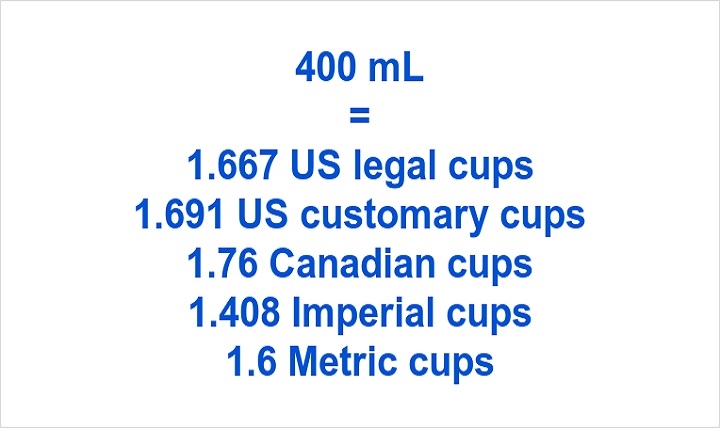
When it comes to cooking or baking, accurate measurements are essential. Often, you’ll come across recipes that require measurements in milliliters (ml), but your kitchen tools may only display measurements in cups. This is a common situation, especially when dealing with liquids or ingredients that aren’t easily converted without some understanding of basic measurement conversions. If you’re wondering how many cups is 400 ml, this article will guide you through the conversion process and its practical applications.
Introduction: The Need for Accurate Measurement Conversions
Conversions between units of measurement can be confusing, especially when preparing a recipe or following instructions that use unfamiliar units. While milliliters (ml) are a standard unit of measurement in many parts of the world, cups are commonly used in the United States and some other countries. This is why understanding how to convert milliliters to cups can be a useful skill in the kitchen. The good news is that this is a relatively simple process, and once you understand the basics, you can convert any liquid measurement accurately.
In this article, we will focus on answering the question, How many cups is 400 ml? and explore related conversions that will help you in everyday kitchen tasks.
Converting 400 ml to Cups: The Basic Conversion Formula
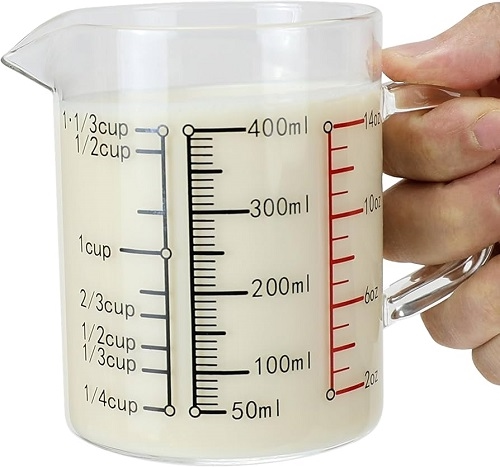
To convert milliliters (ml) to cups, it’s important to know the equivalent measurements. The general conversion factor is:
1 cup = 240 milliliters (ml)
This means that 1 cup is equal to 240 ml. Using this conversion factor, we can calculate the number of cups in 400 ml by dividing 400 by 240:
400 ml ÷ 240 ml per cup = 1.67 cups
Therefore, 400 ml is approximately 1.67 cups. This is useful when you are following a recipe that uses milliliters but only have cups to measure with.
Why Is This Conversion Important?
Accurate conversions are crucial in cooking and baking. Recipes, especially those involving precise measurements like liquids, rely on conversions between units of measurement. If you use the wrong amount, you risk ruining the recipe. For example, using 1 cup instead of 1.67 cups could result in a dish that is too dry or too runny, depending on the ingredients. So, knowing how many cups are in 400 ml (1.67 cups) helps ensure your culinary success.
When Do You Need to Convert 400 ml?
Many recipes use milliliters, particularly in countries that follow the metric system. If you’re in the U.S. or another country that uses cups as the standard measurement, you may encounter milliliters in some recipes. This could include beverages, smoothies, sauces, dressings, or even baking ingredients like milk or water. Understanding how to convert between these measurements will make it easier to follow international recipes or those that use non-traditional measurement systems.
Additional Conversion Considerations
While 1 cup is generally accepted as 240 ml in many culinary contexts, it’s important to note that measurements can vary slightly depending on the country. For example:
- U.S. cup: 240 ml
- Imperial (UK) cup: 284 ml
- Metric cup: 250 ml
These subtle differences are important if you’re working with ingredients that need exact measurements, such as in baking. In the case of 400 ml, it could convert to slightly more than 1.5 cups in the Imperial system, or exactly 1.6 cups in the Metric system. If you’re following a recipe from a different region, be sure to check which standard they are using.
Practical Applications for Converting 400 ml
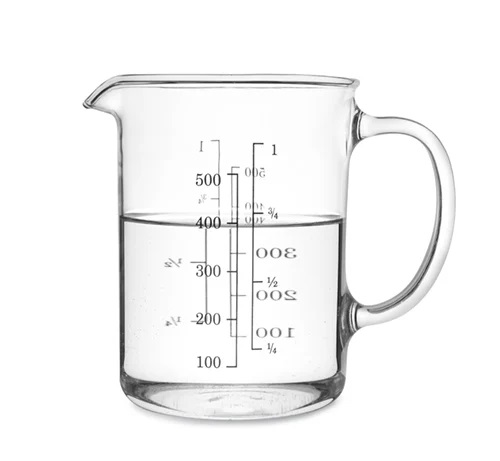
Now that you understand the basic conversion, it’s time to explore some common practical applications where this knowledge will be useful.
Cooking and Baking Recipes
In many international recipes, liquid ingredients like milk, water, or juice are listed in milliliters. Whether you’re making a savory soup or a sweet dessert, understanding the equivalent in cups allows you to follow the recipe correctly. For example:
- 400 ml of water = 1.67 cups
- 400 ml of milk = 1.67 cups
- 400 ml of oil = 1.67 cups
Each of these ingredients can significantly affect the outcome of your dish, so having a clear understanding of how to convert ensures that you add the right amount.
Beverage Measurements
If you enjoy making homemade drinks like smoothies, iced tea, or juice, 400 ml of a liquid is a common measurement. When preparing a drink, the ability to convert milliliters to cups is important for consistency, especially if you are experimenting with different recipes or need to scale a recipe up or down.
For example, to make a smoothie, a recipe might call for 400 ml of milk, which translates to approximately 1.67 cups. If you’re preparing larger batches, this knowledge allows you to quickly adjust the ingredients based on your desired servings.
Ingredient Portioning for Diets
For those who follow strict diet plans, understanding the exact amount of each ingredient is key to managing calorie intake. For example, if you’re tracking your macronutrients and need to measure a specific amount of liquid, knowing that 400 ml is 1.67 cups can be a helpful reference.
Converting in Bulk
If you’re preparing a large quantity of food, such as for a family gathering or a party, being able to convert milliliters into cups is essential. Since many bulk recipes are written with milliliters, it’s common to need quick conversions to ensure you’re using the correct amounts. For instance, making a large batch of sauce or soup may require you to convert multiple amounts from milliliters to cups to get the exact consistency.
FAQs
How many cups is 400 ml in Imperial measurements?
In the Imperial system, 400 ml is approximately 1.41 cups, as the Imperial cup is about 284 ml.
What is the easiest way to convert ml to cups?
To convert ml to cups, simply divide the number of milliliters by 240 (the number of milliliters in a U.S. cup). This gives you the number of cups.
Why do different countries use different cup sizes?
Different countries use varying cup sizes based on their respective measurement systems. The U.S. uses a 240 ml cup, while the UK uses a 284 ml cup, and other countries use the metric cup (250 ml).
How can I measure 400 ml without a measuring cup?
If you don’t have a measuring cup, you can use standard kitchen items. For example, a standard shot glass typically holds about 45 ml, so you would need around 9 shot glasses to make 400 ml.
Can I use the same conversion for solid ingredients?
No, the conversion between milliliters and cups only applies to liquids. Solid ingredients like flour or sugar have different densities and therefore require different conversion factors.
Knowing how to convert milliliters to cups is a practical skill for anyone who enjoys cooking or baking. Whether you’re following a recipe from another country or adjusting measurements for a larger batch, understanding that 400 ml is roughly 1.67 cups ensures you get the right amount of ingredients every time. Accurate measurements help you create better dishes and improve your cooking efficiency, so make sure to keep these conversions in mind as you prepare your next meal or drink.