

When thinking about the passage of time, we often break down our calendars into days, weeks, months, and years. A common question that arises is: how many weeks are in a year? While this might seem straightforward at first glance, the answer can be more complex than you might expect. In this comprehensive guide, we’ll delve into the intricacies of the calendar, understand how weeks are structured, and explore various related concepts that offer a deeper appreciation for the way we measure time.
Understanding the Basics: Days, Weeks, and Years

To determine how many weeks are in a year, it’s essential to understand the basic units of time:
- Day: The fundamental unit of time, typically defined as 24 hours.
- Week: Consists of 7 days.
- Year: Typically consists of 365 days, but this can vary slightly.
How Many Days Are in a Year?
Most of us are familiar with the concept of a year having 365 days. However, every four years, we experience a leap year, which adds an extra day to the calendar, making it 366 days. This adjustment is crucial to keeping our calendar in alignment with the Earth’s revolutions around the Sun.
Calculating the Number of Weeks in a Year
Given that a standard week is made up of 7 days, we can perform a simple calculation to determine the number of weeks in a year:
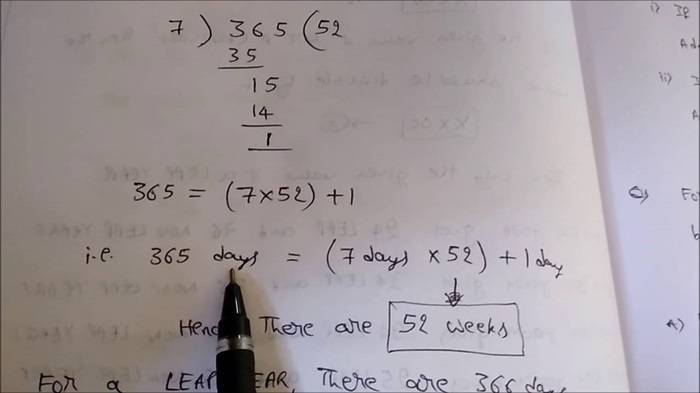
- Non-Leap Year: 365 days ÷ 7 days/week = 52 weeks and 1 day.
- Leap Year: 366 days ÷ 7 days/week = 52 weeks and 2 days.
Therefore, in both leap years and non-leap years, there are always 52 full weeks. The extra days (1 or 2) are what make the calculation interesting and slightly complex.
The Gregorian Calendar: A Brief Overview
The modern calendar we use today is known as the Gregorian calendar, introduced by Pope Gregory XIII in 1582. It was designed to correct the inaccuracies of the Julian calendar, which misaligned the calendar with the solar year by about 11 minutes annually.
Leap Year Rules
The Gregorian calendar introduces a more precise method for determining leap years:
- A year is a leap year if it is divisible by 4.
- However, if the year is divisible by 100, it is not a leap year unless:
- The year is also divisible by 400, in which case it is a leap year.
This system helps ensure that our calendar year stays in close synchronization with the astronomical year.
Weeks in a Year: More Than Just Numbers
While knowing that there are 52 weeks and a few extra days in a year is useful, it’s interesting to delve into how this knowledge impacts our daily lives, businesses, and various cultures.
Weeks in Business and Education

Many businesses and educational institutions structure their activities around the concept of weeks. For instance:
- Work Weeks: The standard workweek typically runs from Monday to Friday, spanning five days, with weekends often considered rest days.
- School Terms: Academic calendars are divided into terms or semesters, which are further broken down into weeks. This structure helps in planning lessons, assignments, and holidays.
Cultural Significance of Weeks
Different cultures have their own interpretations and importance attached to the concept of weeks. For example:
- Religious Observances: Many religions have specific days of the week dedicated to worship or rest. For instance, Sunday is observed as a day of rest in Christianity, while Friday holds special significance in Islam.
- Festivals and Holidays: Many cultural and religious festivals are based on weekly cycles, emphasizing the rhythm and repetition inherent in the concept of weeks.
The Extra Days: How They Fit In
As mentioned earlier, a non-leap year has 52 weeks and 1 day, while a leap year has 52 weeks and 2 days. These extra days can influence how we perceive time and plan our activities.
Year Start and End Days
The extra day(s) mean that each new year starts on a different day of the week than the previous year. For example, if a non-leap year starts on a Monday, the following year will start on a Tuesday. In a leap year, the subsequent year will start on a Wednesday.
Planning and Scheduling
These extra days are also significant in planning long-term projects, vacations, and other activities that require precise scheduling. Understanding the structure of the calendar helps in better managing time and expectations.
Interesting Facts About Weeks and Time
Timekeeping and the division of the calendar into weeks have some fascinating aspects:
- Historical Origins: The seven-day week has its origins in ancient civilizations, including the Babylonians, who associated each day with one of the seven classical planets.
- Astronomical Influence: The seven-day week also correlates with the lunar cycle, which is approximately 29.5 days. This connection highlights the influence of astronomy on our timekeeping systems.
- International Standards: The International Organization for Standardization (ISO) defines Monday as the first day of the week (ISO 8601). However, in some cultures, Sunday is considered the first day.
Leap Seconds and Time Adjustments
In addition to leap years, another interesting aspect of timekeeping is the leap second. This adjustment ensures that our clocks remain in sync with the Earth’s rotation, which can vary slightly. Since 1972, leap seconds have been added sporadically to maintain this alignment.
The Future of Timekeeping
With advancements in technology and our understanding of time, the way we measure and perceive time continues to evolve. Innovations such as atomic clocks provide unprecedented accuracy, and there are ongoing discussions about potential adjustments to our current calendar systems to better reflect astronomical realities.
Potential Calendar Reforms
Some proposed calendar reforms aim to create a more uniform and predictable calendar system. For example, the “World Calendar” suggests a fixed calendar where each year is identical, simplifying planning and scheduling.
Technological Impact
The digital age has brought new ways of tracking and managing time. From online calendars to time management apps, technology plays a crucial role in how we interact with and utilize our time.
Practical Applications of Understanding Weeks in a Year
Having a clear understanding of how many weeks are in a year and the associated nuances can be practically beneficial:
- Project Management: Breaking down projects into weekly segments can enhance productivity and ensure timely completion.
- Financial Planning: Businesses can use weekly cycles to plan budgets, track progress, and make informed decisions.
- Personal Goals: Setting and achieving personal goals becomes more manageable when divided into weekly milestones.
Related Post:
- Exploring the Tangy Delight: Asian Pickled Carrots – Recipes, Health Benefits, and Cultural Significance
- A Clash of Titans: Real Madrid vs. Manchester City – A Rivalry Rooted in History and Ambition
- A Detailed Travel Guide to Morocco’s Enchanting Cities
Embracing the Rhythm of Time
In conclusion, while the simple answer to the question “how many weeks are in a year” is 52, the exploration of this concept reveals a rich tapestry of historical, cultural, and practical implications. Understanding the structure of our calendar, the significance of weeks, and the adjustments made to keep our timekeeping systems accurate provides a deeper appreciation for the intricate rhythm of time that governs our lives.
Whether for planning, productivity, or personal insight, recognizing the full context of how weeks fit into a year enriches our interaction with time, helping us make the most of every moment.