

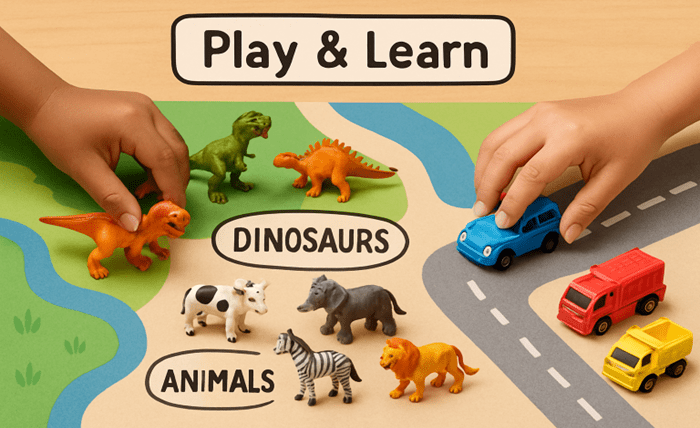
Miniature toys are not just playthings in academic lexis, they support children’s imaginative play, curiosity, and experiential play. These diminutive representations, like farm animal toys, turn standard play spaces into places where children can construct stories, build narratives, and develop understanding. When adults present themes of toys like farm animals, marine animals, and dinosaurs, they help to extend children’s investigations into new ideas, enabling their thinking, and ultimately supporting their learning for the future.
Imaginative Play, Storytelling, and Categorization
In addition to providing kids limitless opportunities to create stories, organize their thinking, create new solutions to problems and practice language in a no-lose environment, miniature toys help a student develop empathy and emotional intelligence through the perspective of others. Miniature toys also assist with student conceptualization of sorting and classification. This can be as simple as sorting miniatures based on color, shape, habitat, or any trait of the species. Activities that require animals to be categorized or classified develop critical thinking skills and logical reasoning and help provide students with a foundation in math and science. This unique blend of spontaneous creativity along with a little structure promotes lifelong learning and learning in general, as well as cognitive, emotional and problem-solving skills.
Tactile Learning and Science Exploration with Miniature Toys
Sensory bins filled with rice, sand or water beads give children some tactile learning while focusing on the elements of texture, fine motor development and story creation. They are also great for developing elements of memory, object permanence and hand-eye coordination. Miniature animals simplify scientific concepts for children, creating an experience for the children to engage in habitats, food chains and animal adaptations. By taking the abstract and original, and creating a tangible reality for the learning process will help the learning become more salient.
Developing Social Skills Through Group Play
Using small toy figures in small groups or partners can be a great way for a child to learn communication, cooperation, and empathy. As the children interact with the toys, they get to create stories or patterns collaboratively which allows for sharing ideas, negotiating and compromising. Collaborative play emphasizes connection, perspective-taking, and teamwork. Mini figures also provide structure for play for children who may feel shy/awkward or overwhelmed, they can participate but not feel as vulnerable. This type of collaborative play often leads to stronger friendships, and a better understanding of their social exchanges to be respectful.
Art Projects and Crafts
Mini toys facilitate creativity through art in so many ways, such as building dioramas, painting backdrops, and creating miniature landscapes. Mini toys develop problem-solving skills and help children’s fine motor skills and spatial reasoning. Children can explore their mini figures as the tacit parts of their craft projects. This allows them to visualize their stories and lessons and encourages children to deeply engage in the learning in a developmental way while allowing them to be individuals. Once their projects are finished, children can also share and come together with their displays so they can feel involved in one singular project.
Math Concepts and Pattern Recognition
Little toys can help students see math as less abstract and thus more enjoyable – making mathematical concepts into fun activities! Students can count toy animals, sort toy animals into patterns, group the toy animals into simple addition or subtraction questions, or order the toy animals. Many of the patterning activities with the toys, like alternating colors or sorting figures by size, enhance learning observation and logic skills first. There is nothing like having enjoyable math activities to build confidence with dealing with mathematical ideas in a personal context.
Language Development and Vocabulary Building
Mini figures support language development in that children can focus on new words and descriptive phrases. There are so many times when children are playing with their toy animals that they easily expand their vocabulary in a natural way, and then even start using more complex sentences when asked to describe their animal. It is through the connections found in role play and storytelling that children experiment with language, develop stories, and make concepts meaningful in a context that is valid and real. All of these concepts lead to enrichment in child development across all domains. The creativity engaged while storytelling and making connections builds important skills while making learning fun and a lifelong journey. Miniature toys help provide meaningful and enriching experiences while engaging children with play and learning.
Wrap Up
Using tiny toys to support play and learning gives so much more than simple fun; it promotes creativity, builds basic skills, and makes learning an active fun experience! Tiny toys are perfect for imaginary storytelling, and can emphasize math, science and social skills; tiny toys can help in engageable experiences that play an important role in a child’s development. By embedding tiny toys into the everyday, families and educators can create play-based learning experiences that inspire curiosity and a scaffolding toward lifelong curiosity.