


When it comes to weight conversions, understanding how many ounces are in a kilogram is essential for many different activities, ranging from cooking to international shipping. The concept of ounces and kilograms is rooted in different measurement systems – the imperial system and the metric system, respectively. In this article, we will break down the conversion process, offer practical applications, and address some commonly asked questions related to weight measurement.
Understanding Ounces and Kilograms
Before diving into the conversion, it’s important to understand the basic concepts of ounces and kilograms.
What is an Ounce?
An ounce (oz) is a unit of weight that is used in the imperial system of measurement. It is commonly used in the United States for measuring food products, mail, and other everyday items. One ounce is equal to 1/16th of a pound, or approximately 28.35 grams in the metric system.
What is a Kilogram?
A kilogram (kg), on the other hand, is a unit of weight in the metric system. It is the base unit of mass in the International System of Units (SI). One kilogram is equal to 1000 grams and is widely used around the world for measuring weight. Unlike the ounce, the kilogram is part of the metric system, which is used almost universally except in countries like the U.S. that still primarily use the imperial system.
How Many Ounces in a Kilogram?
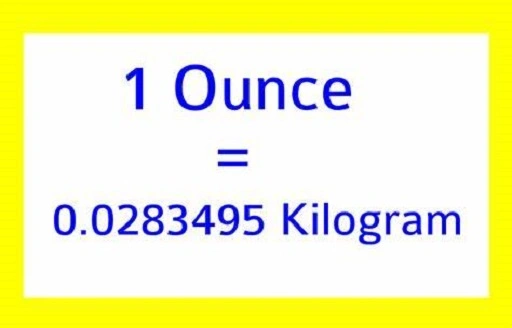
To convert kilograms to ounces, it’s crucial to understand the exact relationship between these two units. One kilogram is equivalent to approximately 35.274 ounces.
Conversion Formula
To convert kilograms to ounces, the formula is simple:
Ounces=Kilograms×35.274\text{Ounces} = \text{Kilograms} \times 35.274Ounces=Kilograms×35.274
For example, if you have 5 kilograms and you want to know how many ounces that is, you would perform the following calculation:
5 kg×35.274=176.37 oz\text{5 kg} \times 35.274 = \text{176.37 oz}5 kg×35.274=176.37 oz
So, 5 kilograms equals 176.37 ounces.
Practical Applications of Kilogram to Ounce Conversion
Understanding how many ounces are in a kilogram can be helpful in various real-world situations, especially when working with different measurement systems.
Cooking and Recipes
One of the most common scenarios in which you need to know the conversion from kilograms to ounces is in cooking and baking. Recipes from different countries often use either the metric or imperial system, so knowing how to convert can be essential for accurately preparing meals. For instance, a recipe might call for 250 grams of flour, and you might need to know how many ounces that is. Since 1 gram equals approximately 0.035 ounces, you can multiply the number of grams by 0.035 to convert it to ounces.
Travel and International Shipping
When traveling or shipping goods internationally, it’s important to understand weight conversions. Different countries use different measurement systems for weight, so knowing how many ounces are in a kilogram can help you understand luggage weight restrictions or international shipping costs. Most airlines will require you to know your baggage weight in kilograms, but luggage scales often use ounces or pounds.
Body Weight and Fitness
Another area where this conversion is important is in fitness and body weight management. Many fitness tracking apps use pounds and ounces, while others may use kilograms. By understanding how to convert kilograms to ounces, you can accurately track and compare your progress.
Factors Affecting Weight Measurement

While the conversion from kilograms to ounces is straightforward, several factors may impact weight measurements.
Precision in Measurement
Precision is key when measuring weight for scientific experiments, cooking, or other activities. Scales and measuring devices may provide readings in different units of measurement, so it’s important to use the correct conversion formula to ensure accuracy.
Weight vs. Mass
While “weight” and “mass” are often used interchangeably, they are different. Weight is a force that results from gravity acting on an object’s mass. Mass is a measure of the amount of matter in an object, while weight can change depending on the force of gravity, which varies from place to place. The conversion between kilograms and ounces is based on standard conditions at sea level on Earth, where gravity is constant.
Environmental Factors
Temperature and humidity can also affect the weight of certain objects, particularly in scientific settings. For instance, objects in water may weigh differently due to buoyancy, and sensitive instruments like balances are calibrated to account for environmental factors.
FAQs About Kilograms and Ounces
How do I convert kilograms to ounces manually?
To convert kilograms to ounces, simply multiply the number of kilograms by 35.274. For example, 2 kg equals 2 x 35.274 = 70.548 ounces.
How many ounces are in 1.5 kilograms?
To find the number of ounces in 1.5 kilograms, multiply 1.5 by 35.274. This equals 52.911 ounces.
Why is the kilogram used instead of the pound in many countries?
The kilogram is part of the metric system, which is widely used worldwide because it is based on units of 10, making it easier to convert between different measurements. The imperial system, which uses pounds, is still used in a few countries, notably the United States.
How many grams are in 35 ounces?
To convert ounces to grams, multiply the number of ounces by 28.35. So, 35 ounces equals 35 x 28.35 = 991.25 grams.
Is there a simpler way to convert kilograms to ounces without a calculator?
A quick method for estimation is to multiply the number of kilograms by 35. While this won’t give you an exact number, it will provide a good approximation for most practical uses.
Understanding the conversion from kilograms to ounces is crucial for a wide variety of applications, whether in the kitchen, while traveling, or in scientific research. With the simple formula, “kilograms × 35.274 = ounces,” anyone can convert between these two units with ease. This knowledge can also help when dealing with international standards, as the metric system continues to dominate globally. So next time you’re faced with a weight conversion, you’ll be ready to quickly and accurately convert kilograms into ounces.