


Understanding unit conversions is essential in various fields such as science, medicine, and daily life. Among these conversions, the question of how many nanograms are in a gram is often asked. This article will provide a detailed explanation of the relationship between nanograms and grams, along with practical examples and relevant information to help clarify the conversion process.
What is a Nanogram?

A nanogram (ng) is a metric unit of mass in the metric system. The prefix “nano” refers to one-billionth of a unit, which means that a nanogram is one-billionth of a gram. It is commonly used when measuring very small quantities, especially in scientific fields like chemistry, biology, and physics.
Definition and Size of a Nanogram
To put it in perspective, a nanogram is extremely small. It is represented as:
1 ng = 0.000000001 grams.
This makes nanograms useful when dealing with minute quantities, such as drug doses, concentrations in solutions, or particles in air.
What is a Gram?
A gram (g) is a standard unit of mass in the metric system and is widely used across the world. It is the base unit for mass in the International System of Units (SI) and serves as a reference point for other measurements.
Definition and Size of a Gram
1 gram (g) = 1,000 milligrams (mg) = 1,000,000 micrograms (µg) = 1,000,000,000 nanograms (ng).
In simpler terms, the gram is a much larger unit than the nanogram. It is used for measuring everyday objects, food quantities, and body weight, among other things.
The Conversion: How Many Nanograms in a Gram?
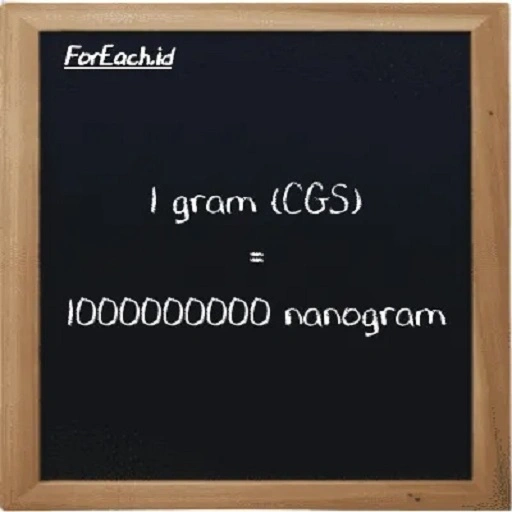
Now that we have an understanding of the gram and nanogram, it’s important to answer the key question: How many nanograms are there in a gram?
Conversion Formula
The conversion between grams and nanograms is straightforward. Since 1 gram equals 1,000,000,000 nanograms, you can use the following formula to convert from grams to nanograms:
1 gram = 1,000,000,000 nanograms (ng).
This means that a single gram contains one billion nanograms. For instance, if you have 2 grams, it would be:
2 grams = 2,000,000,000 nanograms.
Example of Nanogram to Gram Conversion
To better understand how this conversion works in real-world scenarios, let’s look at a few examples:
- Example 1: If a chemical substance weighs 0.5 grams, how many nanograms is that?
- Conversion: 0.5 grams × 1,000,000,000 = 500,000,000 nanograms.
- Example 2: If you have a particle that weighs 2.5 nanograms, how many grams is it?
- Conversion: 2.5 nanograms ÷ 1,000,000,000 = 0.0000000025 grams.
These examples highlight how nanograms are used to measure very small quantities and the importance of understanding the conversion for accurate measurements.
Practical Uses of Nanograms
Nanograms are commonly used in many scientific fields. Some practical applications of nanograms include:
Medicine and Pharmacology
In medicine, nanograms are often used to measure very small doses of medication, especially for potent drugs like hormones, vaccines, and steroids. For instance, the precise measurement of nanograms is crucial for determining the correct dosage to avoid harmful side effects.
Environmental Science
In environmental science, nanograms are used to measure pollutants in the air, water, and soil. Due to the small scale of these measurements, nanograms help quantify trace amounts of harmful substances such as heavy metals and toxins.
Chemistry and Biology
In chemical analysis and biology, nanograms are used to measure substances in solutions, such as concentrations of proteins, enzymes, and DNA. These measurements are critical in research and experiments that require high precision.
Why Is Understanding Nanogram to Gram Conversion Important?

Understanding how many nanograms are in a gram is essential for several reasons:
Accuracy in Scientific Research
In fields like chemistry and biology, accurate measurements are critical. Many substances, especially in biotechnology, are measured in nanograms to ensure proper experimentation and results.
Pharmaceutical Applications
As mentioned earlier, pharmaceuticals often require very precise doses, which can be measured in nanograms. Understanding the conversion between grams and nanograms ensures the correct application of medicine, especially in clinical settings.
Environmental Monitoring
Environmental scientists need to measure very low levels of contaminants in ecosystems. Nanograms are used to detect pollutants in minute quantities, ensuring accurate environmental assessments and regulations.
Frequently Asked Questions (FAQs)
How many nanograms are in a gram?
1 gram is equal to 1,000,000,000 nanograms.
Can I convert nanograms to grams easily?
Yes, to convert nanograms to grams, simply divide the number of nanograms by 1,000,000,000.
How do I convert 2 grams to nanograms?
To convert 2 grams to nanograms, multiply 2 by 1,000,000,000. So, 2 grams = 2,000,000,000 nanograms.
Why do we use nanograms in science?
Nanograms are used in science because they help measure extremely small quantities, which is crucial in fields like pharmacology, chemistry, and biology.
Is a nanogram smaller than a milligram?
Yes, a nanogram is much smaller than a milligram. 1 milligram equals 1,000,000 nanograms.
Understanding how many nanograms are in a gram is vital for various fields, from scientific research to medicine. A gram contains 1 billion nanograms, which makes it an essential unit of measurement for measuring very small quantities. By mastering this conversion, you ensure accuracy in your work, especially in areas requiring precise measurements.