

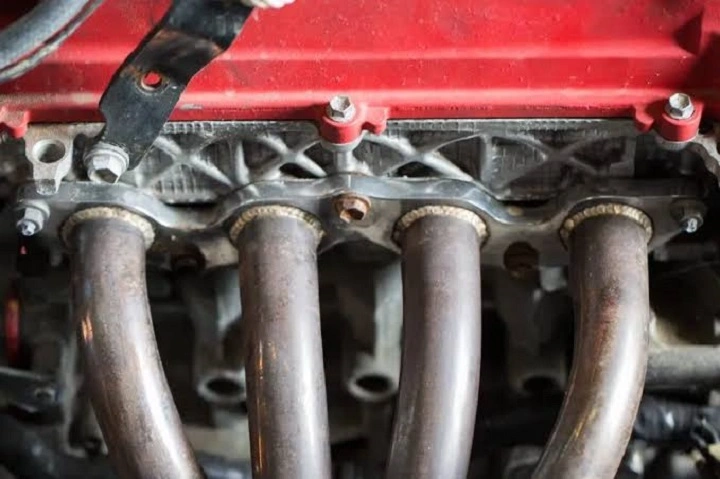
An exhaust leak can cause a misfire. However this is only the case under certain conditions. In most cases the misfire will be caused by something else unrelated to the exhaust system. The most common cause of a misfire is the engine’s failure to fire which is in most cases related to the ignition system. An exhaust leak near the engine or oxygen sensors can cause a misfire due to false readings of the oxygen sensors which will cause the engine to run improperly.
So if you have an exhaust leak with a misfire they are very likely related.
What is an Exhaust Leak?
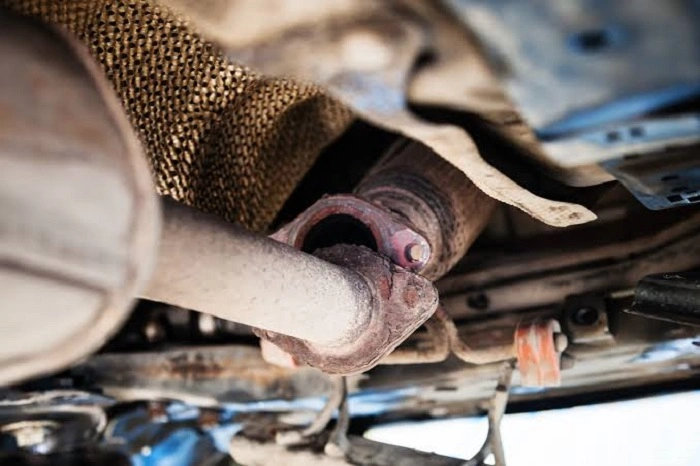
An exhaust leak is a leak in the exhaust system that causes the engine to expel gases prematurely. The leaks are most commonly found in:
- the exhaust manifolds and gaskets,
- flex pipe,
- exhaust pipe,
- connection to the catalytic converter,
- muffler, tail pipe
These leaks are most commonly found on the first few feet from the tail pipe because the exhaust system closest to the engine tends to be the hottest which causes cracking.
What is an Engine Misfire?
An engine misfire is a condition where one or more cylinders in the engine misfire. The causes of a misfiring engine can be:
- worn improperly seated spark plugs,
- improper functioning of ignition coils,
- fuel injection problems,
- vacuum leaks,
- loss of compression,
- fuel system problems.
The most common symptom of an engine misfiring is rough idle but the loss of power can also be a symptom of a misfiring engine.
So how can an exhaust leak result in a misfire?
Modern cars have oxygen sensors that indicate to the computer how much oxygen is in the exhaust. An exhaust leak can cause false readings of the oxygen sensors resulting in an engine running rich or lean which could result in the engine misfiring. An exhaust leak that occurs before the oxygen sensor will cause false readings from the sensor resulting in an improper air to fuel ratio that could cause the engine to misfire.
The oxygen sensor will give off false readings if there is an exhaust leak before the oxygen sensor which causes the improper air to fuel ratio which could lead the engine to misfire.
Symptoms of an Exhaust Leak
Common symptoms are:
- loud ticking sound when the engine is off,
- hissing sound,
- ability to smell the exhaust fumes,
- poor fuel economy,
- loss of power,
- check engine light,
- loud exhaust,
- rough idle
Loud noises coming from the exhaust system are usually an indicator that there is an exhaust leak, especially if there are other symptoms. The most common cause of these noises is the small leaks that occur which only worsen once the engine is warmed up.
Symptoms of an Engine Misfire
Common symptoms are:
- shaking or vibrating of the engine,
- rough idle,
- loss of power,
- poor fuel economy,
- check engine light,
- increase in engine emissions
If the check engine light is flashing it means that the misfire is severe. The car should be towed to a mechanic.
Can a small leak cause any problems?
A small leak in the exhaust system will only cause problems if the leak is in a certain place. A small leak in the muffler shouldn’t cause many problems, but a small leak in the manifold could cause quite a bit of issues. It depends on the location of the leak and how close the leak is to the oxygen sensors or the engine, if the leak is close to the engine it could cause the engine to behave erratically.
How is the problem diagnosed?
There are several tests that a mechanic can perform in order to identify the cause of the misfiring like:
- checking trouble codes,
- test for exhaust leaks,
- checking the oxygen sensor,
- checking the ignition system,
- checking for vacuum leaks,
- using a smoke test for checking exhaust leaks.
After these tests are completed the mechanic will be able to determine the cause for the engine misfiring.
Also Read: What Makes Stainless Steel Stainless? How It Resists Rust Explained
How is the exhaust leak repaired?
The course of action that a mechanic takes in order to repair the exhaust leak depends on the location of the leak. After the mechanic finds where the leak is he can move on to the next step which is sealing the leak by replacing the gaskets and other parts if necessary.
The other methods that a mechanic can use are:
- repairing cracked manifolds,
- welding,
- refitting the flex pipe,
- tightening connections,
- replacing the oxygen sensor
If the problem is unrelated to the exhaust system the mechanic can repair the ignition system or the fuel system if necessary.
Can I continue driving with it?
It depends on how severe the leak is. If you have a small leak you can continue driving. But you should bring your car to a mechanic as soon as possible. You shouldn’t continue driving if you have a serious leak. Don’t drive if the check engine light is on or if the engine is misfiring. Continuing to drive with an exhaust leak can cause permanent damage to your engine.
Preventing Exhaust Leaks
The best way to avoid exhaust leaks is to perform regular maintenance on a periodic basis. Following some of the recommendations below can help you prevent exhaust leaks.
- Regular exhaust system inspection,
- repairing rust spots,
- replacing broken gaskets,
- avoiding hitting large objects on the road that can crack the exhaust system,
- addressing the check engine light
If you perform regular maintenance and address the smaller issues you can avoid major malfunctions.
An exhaust leak can cause a misfire if the leak is located close to the engine or oxygen sensors. In most cases the misfire will be caused by something else unrelated to the exhaust system which is why it is important to have both, the exhaust system and the ignition system inspected if you think that there is a problem with either of them.
FAQs
Can exhaust manifold leak cause a misfire?
An exhaust manifold leak can cause a misfire. This happens when the malfunction is located in the area of the exhaust manifold. The false readings of the oxygen sensor can cause the engine misfire.
Can fixing the exhaust system fix the misfiring engine?
Once the malfunctions in the exhaust system are resolved the misfiring should be resolved as well. If it is not, the mechanic will determine the cause for the misfiring and address it.