

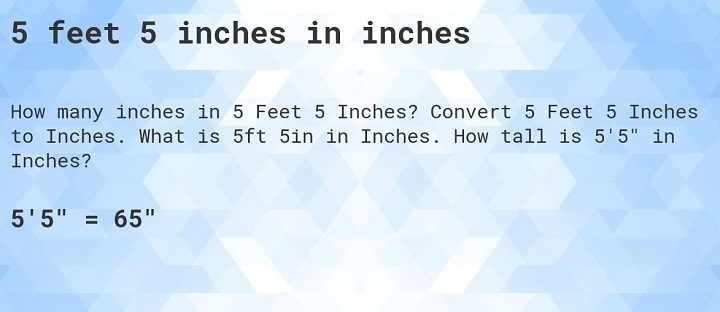
When it comes to expressing height in written form, accuracy and clarity are crucial. Whether you are writing a document, a resume, or a personal bio, knowing how to properly write measurements is important.
Understanding the Basic Structure of Height Measurements
The Components of Height
The measurement “5 feet 5 inches” consists of two parts:
- Feet: This is the larger unit used to measure height in the imperial system. One foot equals 12 inches.
- Inches: A smaller unit used to represent portions of a foot. There are 12 inches in one foot.
In the United States and many other countries, height is commonly measured in feet and inches.
Common Notations for Height
There are different ways to write and express “5 feet 5 inches,” depending on the context or the system used. Let’s explore some of the most common notations for height.
Writing in Full Form
The full form is the most traditional and formal way to express height. For example:
- “5 feet 5 inches” is the most direct and commonly used format in writing. It clearly indicates both units, making it easy to understand.
Abbreviating Feet and Inches
Often, space or simplicity is desired, so people may abbreviate the terms “feet” and “inches.” The abbreviation format commonly used is:
- “5′ 5″” (5 feet 5 inches)
Here, the single quotation mark (‘) denotes feet, and the double quotation mark (“) represents inches.
Expressing Height in Centimeters
In some contexts, particularly outside of the United States, height is measured in centimeters (cm) instead of feet and inches. To convert 5 feet 5 inches into centimeters:
1 foot = 30.48 cm
1 inch = 2.54 cm
Using these conversion factors:
- 5 feet = 5 × 30.48 = 152.4 cm
- 5 inches = 5 × 2.54 = 12.7 cm
Therefore, 5 feet 5 inches equals 152.4 cm + 12.7 cm = 165.1 cm.
Using a Fractional Measurement
Another way to write height is by using a fractional measurement instead of inches. For example, 5 feet 5 inches can be written as:
- “5 feet 5/12” feet. Here, 5/12 is the fraction representing the 5 inches out of the 12 inches in a full foot.
This format is less common but might be used in more scientific or mathematical contexts.
Common Scenarios for Writing Height
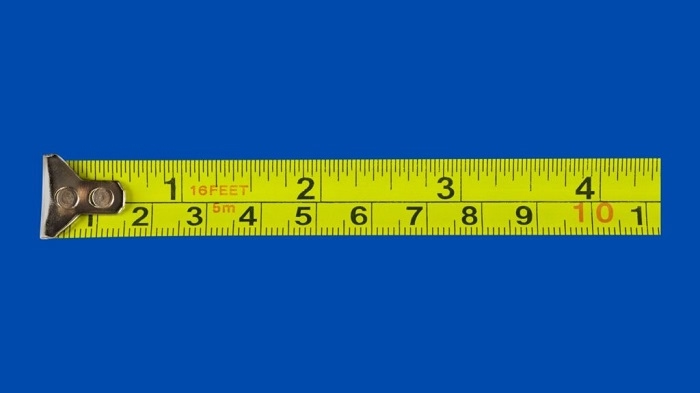
In Personal Documents
In personal documents like resumes or forms, it is common to use the abbreviated form (5′ 5″) for simplicity. However, in official medical records, some formats may prefer writing the height in full (5 feet 5 inches).
In Global Contexts
Outside the United States, many countries prefer the metric system, where height is written in centimeters. If you are submitting a height measurement for international purposes (e.g., visa applications), you may need to convert it from feet and inches to centimeters, as mentioned earlier.
In Scientific and Academic Writing
When writing scientific or academic papers, the full form (5 feet 5 inches) is usually preferred for clarity. In more formal settings, the measurement should be precise, and ambiguity should be minimized.
In Casual Writing
In more casual or creative writing, the abbreviated form (5′ 5″) is widely accepted. In informal settings, such as casual conversations, expressing height in feet and inches can be done with abbreviations to save space or for simplicity.
How to Express Height in Different Units
Converting Feet and Inches to Meters
For international readers, height is often written in meters, particularly in countries that use the metric system. To convert 5 feet 5 inches to meters:
- 1 foot = 0.3048 meters
- 1 inch = 0.0254 meters
Using the conversion factors:
- 5 feet = 5 × 0.3048 = 1.524 meters
- 5 inches = 5 × 0.0254 = 0.127 meters
Therefore, 5 feet 5 inches equals 1.524 meters + 0.127 meters = 1.651 meters.
Using Decimal Form
Sometimes, especially in scientific contexts, people might prefer expressing height as a decimal. For example, 5 feet 5 inches can be written as 5.42 feet (since 5 inches is 5/12 of a foot).
This format allows for quick calculations and comparisons between different height measurements in certain professional fields.
When to Use Different Height Formats
Professional and Official Use
In professional and official settings, it is important to use the format that is expected by the institution or organization. For example, a medical form may request height in feet and inches, but a scientific paper may require height to be written in meters.
Casual and Personal Use
For informal purposes, such as introductions or social media bios, the abbreviated format (5′ 5″) is perfectly acceptable. It is quick, clear, and widely understood.
International Use
When traveling abroad or applying for documents internationally, it’s crucial to know how to convert your height from feet and inches to the metric system. In many countries, the metric system is preferred, and height is recorded in centimeters or meters.
Tips for Writing Height Accurately
Use Consistent Units
When recording or writing your height, be consistent with the units you are using. If you start with feet and inches, continue using that system throughout your document or conversation. Similarly, if you begin using the metric system, stick with it.
Double-Check Your Conversions
If you’re converting from one system to another, always double-check your conversions. Mistakes in measurement can lead to confusion or errors in official documents.
Write Clearly
Regardless of the format you choose, ensure that your height is easy to understand. Avoid unnecessary abbreviations or fractions unless you’re writing in a scientific or technical context where they are required.
FAQs
1. How do I write 5 feet 5 inches in centimeters?
To write 5 feet 5 inches in centimeters, convert each unit: 5 feet = 152.4 cm, 5 inches = 12.7 cm. The total is 165.1 cm.
2. What is the correct abbreviation for feet and inches?
The correct abbreviation for feet and inches is “5′ 5″” (5 feet 5 inches).
3. Can I use feet and inches in formal writing?
Yes, feet and inches are acceptable in formal writing, especially in countries like the United States where this system is standard.
4. How do I convert feet and inches to meters?
To convert feet and inches to meters, multiply the number of feet by 0.3048 and the number of inches by 0.0254, then add the results together.
5. What is the decimal form of 5 feet 5 inches?
The decimal form of 5 feet 5 inches is approximately 5.42 feet.