

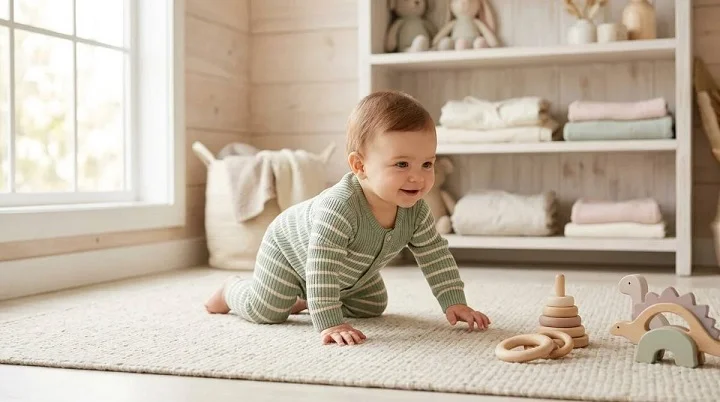
A common question among many parents is when will their baby crawl?
Crawling starts between 6 and 10 months, with a large range of normal.
Some babies crawl early, some later and some never crawl, but pull up, cruise or walk.
When Does The Baby Start Crawling?
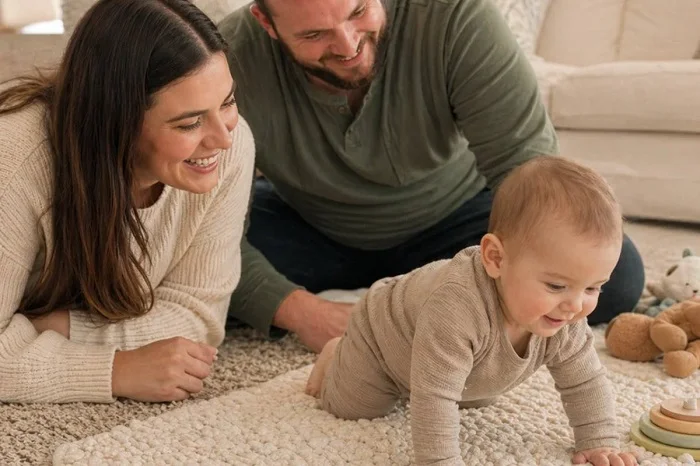
Babies begin crawling at about 7–10 months of age.
Every baby grows at his/her own rate, though.
Some children may start crawling on the floor around 6 months old, others may not crawl until later.
Every baby is different and there isn’t an exact age for this.
The Signs of a Baby Who’s Ready to Crawl.
Kids typically have more muscle control and coordination before crawling.
It may be accompanied by symptoms like:
- Better head control
- Sitting with minimal support
- More powerful arms and shoulders
- Rolling, crawling, or creeping on the floor
- Getting to toys on the floor
- Lying down and turning/pivoting at that time.
- Attempting to cross the field to either side. Walking toward or from the opposite side of the field.
- With arms pushing up
These signs may develop over a period of time.
How do babies crawl?
No.
Babies don’t only walk, they move in many different ways until they walk.
Some common forms of crawling are:
- Hands-and-knees crawling
- Belly crawling
- Commando crawling
- Bottom shuffling
- aim to roll to reach objects (ensure that rolling is done carefully)
- Scooting while sitting
Some babies employ more than one style.
Is it OK for babies to not crawl?
Yes.
Not all babies crawl in the ‘hands and knees’ style.
They can scoot, roll or shuffle and eventually stand and walk.
Crawling is not a sign of a problem if it is not done.
A doctor typically examines the overall movement, strength and development and not a single milestone.
Do Babies Start Crawling on Hands and Knees?
Most crawling with hands and knees occurs around 7-10 months.
Prior to this, the baby could have spent time rocking back and forth on hands and knees.
They can also be pushed backward by accident when they haven’t yet learned to walk forward.
Why does my baby crawl backwards?
Going backwards while crawling is normal.
Initially, a baby’s arms may be stronger than the legs.
The body may roll back instead of forward when the baby pushes with arms.
Many babies learn to move forward as their coordination improves.
What can I do to get my baby crawling?
Babies can’t be made to crawl – but they can be provided with safe opportunities to practise moving.
You can:
- Provide regular supervised tummy time
- Put toys just out of reach of the child
- Permit floor play on safe surface
- Support reaching and turning
- Allow the baby to move around.
- Avoid excessive sitting/sitting on devices that impair motion
Floor play develops the arm and shoulder, neck, back and core muscles.
Why is Tummy Time Important?
Tummy time supports development of muscles that contribute to a variety of physical milestones.
It can strengthen:
- Neck muscles
- Shoulder muscles
- Arms
- Back
- Core
These muscles can then be used to assist in sitting, crawling and other movements.
Tummy time should be supervised at all times when the baby is awake.
What if My Baby Doesn’t Like Tummy Time?
Not all babies like tummy time.
Try shorter sessions more frequently during the day.
You may also:
- Keep baby face to face with you while lying down
- Put a toy nearby
- Lay baby on chest during awakening
- Always play on a safe play mat.
Slowly working up to more tummy time might help.
Should the use of baby walkers aid in crawling?
Baby walkers that have wheels should not be used to teach babies to crawl or walk.
They don’t support babies’ natural movement patterns and can pose safety hazards.
Rather than safe floor play, this is typically a better approach to the support of physical development.
So, once your baby begins crawling, what should you do?
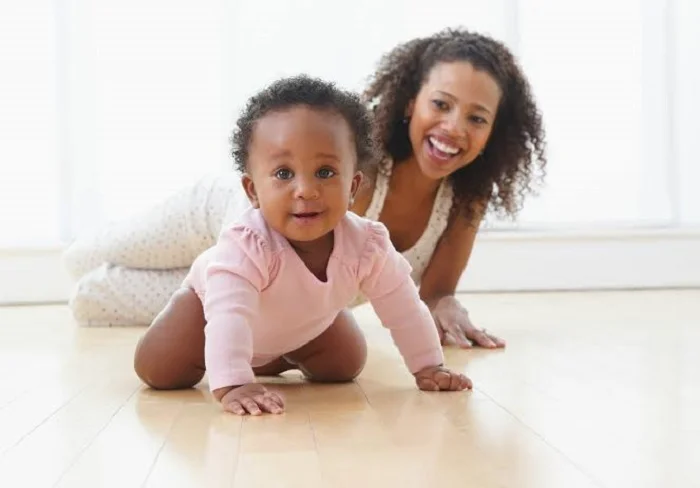
When the baby starts crawling, she or he will have access to many things that was out of reach.
Baby-proofing is suddenly very important.
Consider:
- Covering electrical outlets
- Securing furniture
- Blocking stairs
- Locking medicine cabinets to prevent access to children and young people.
- Cleaning up small choking hazards
- Ensuring cleaning products are always stored securely
- Moving sharp or breakable objects
- Avoiding cords that are dangling or hanging
When babies learn to crawl, they can move rather quickly.
Also Read: Discount Stores Near Me: How to Find the Best Deals Nearby
At What Age Do Babies Crawl Before Walking?
Some babies start crawling before they walk, but some don’t.
Many babies begin:
- Sitting independently before crawling
- Crawling before pulling to stand
- Pushing to stand, before cruising.
- Children are able to cruise before independent walking.Children can cruise prior to walking by themselves.
The order and timing can vary.
When should I talk to my pediatrician?
A baby’s development may progress at a different rate, but consult with a pediatrician if you think there are problems with movement or development.
It is particularly worth discussing in the event your baby:
- Seems very stiff or very floppy
- Prefers to use one limb more than the other
- Has difficulty controlling the head
- Is not showing progress in movement over time
- Forfeits a skill that they previously possessed
- Appears not to be able to hold up weight when asked at their age
Your pediatrician can assess the baby’s overall development and determine if additional testing is necessary.
Babies typically begin crawling between the ages of 6 and 10 months. But they may crawl earlier or later.
Crawling on hands and knees, belly crawling, scooting or any other way of crawling.
Not all babies make the transition to crawling.
To support crawling you should ensure that lots of safe floor time is provided, tummy time is supervised and opportunities to reach and move.
Talk to a pediatrics physician if you are concerned about your baby’s movement.
FAQs
On average, when do babies begin crawling?
The normal age of crawling is around 7-10 months, but it can be earlier or later.
Is it okay if a baby doesn’t crawl at 9 months?
It can be. Some babies crawl at different ages and some use other methods of movement.