

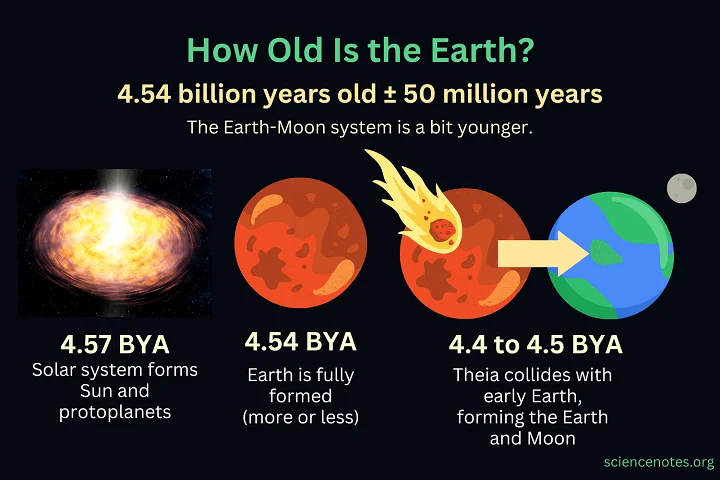
The Earth is estimated to be 4,540 million years old.
This is an estimation made by scientists. They have studied very old rocks, meteorites and the radioactive elements within them.
The age of the Earth is not the age of one rock, or one test. Rather, it is derived from several approaches that lead to the same conclusion.
How Old is the Earth?
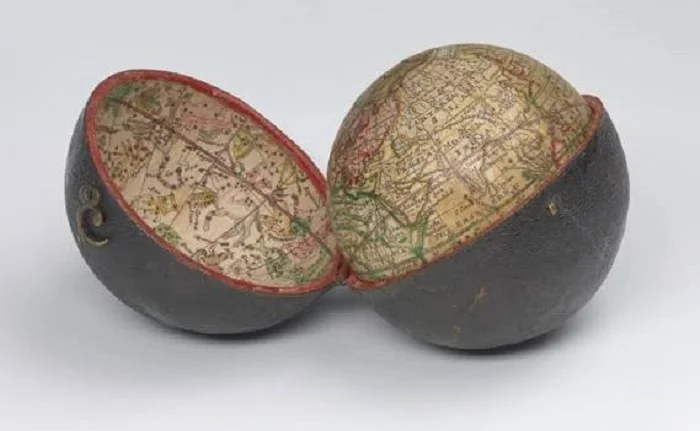
Estimated age of the earth is about:
4.54 billion years old
That is, the Earth was born approximately 4.5 billion years ago.
In general, scientists estimate the age of rocks with a relatively narrow range of values due to the fact that the dating techniques are very precise and are not absolute with regard to the age.
How can scientists determine the age of the earth?
Radiometric dating is a method used by scientists.
This technique can be used to determine the rates of decay of radioactive substances.
Some components decompose at a known rate.
Scientists can calculate how much of the original element and how much of the material that it has transformed into there are, to estimate the length of time that it has been occurring.
So, what is radiometric dating?
The age of rocks and minerals can be estimated by a process called radiometric dating.
Certain atoms are unstable and will change into different atoms over time.
This process is known as radioactive decay.
The rate at which each radioactive element decays is known, and is referred to as its half-life.
This known rate is used by scientists like a clock.
What is the half-life of a radioactive element?
The half-life of a radioactive element is the time required for 50% of the radioactive atoms to undergo decay.
A radioactive substance with a half-life of 1 billion years would have a half life of 1 billion years. After 1 billion years, 50% of the material would still be radioactive.
In another billion years, half of the remaining would be converted back.
Scientists can use the amounts to estimate the age of a sample by making comparisons.
Why Not Date the Oldest Rock on Earth?
Earth’s surface is constantly changing.
Rocks are:
- Melted
- Broken down
- Buried
- Recycled
- Underwent a change of form through heating and pressure.
The world’s oldest rocks are not present today due to the forces of erosion and plate tectonics.
It is for this reason that meteorites are also studied.
Why Are Meteorites Important?
The meteorites are the rocks that were created around the same time the solar system formed.
A number of meteorites have not changed significantly since they were formed.
Dating meteorites provides a clue to the age of the solar system, including the earth.
Meteorites are dated by a radiometric clock which yields ages around 4.5 billion years.
What are the rocks that are the oldest on Earth?
The oldest rocks on earth date back over 4 billion years!
Very old mineral crystals called zircons have also been found.
There are some Zircon crystals that are approximately 4.4 billion years old.
The old material confirms the idea of the formation of the Earth more than 4.5 billion years ago.
What is the age of the Solar System?
The sun’s age is estimated to be 4.6 billion years.
The Earth was formed very early in the formation of the solar system, close to the Sun.
That is why the estimated age of the Earth is a little younger than the age of the solar system.
Is the Earth always like this?
No.
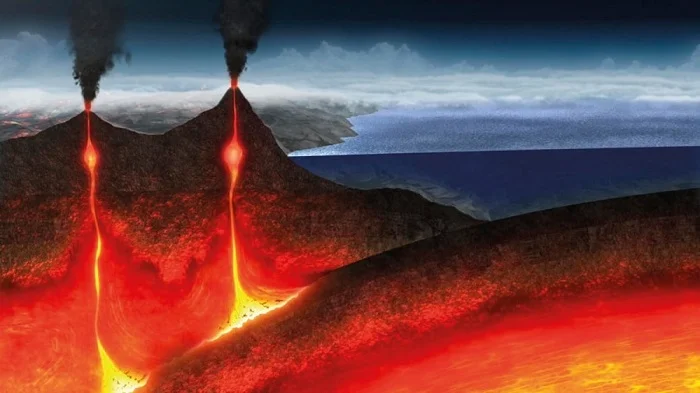
The early Earth was vastly different from the Earth today.
It was much warmer and impacted by asteroids and other objects more often.
Over time:
- The surface cooled
- A crust formed
- Oceans developed
- The atmosphere changed
- Life eventually appeared
Through its history the planet has also been changing.
What was the earliest point in Earth’s history when life began?
The precise date has yet to be investigated.
There is evidence of life on Earth over 3.5 billion years ago.
There is some evidence suggesting that the earliest signs may be even earlier, but scientists are still studying and debating the oldest signs.
Life started after Earth was formed.
Also Read: What Time Zone Am I In? How to Find Your Current Time Zone
What is the age of the Earth in comparison to the age of the Universe?
Earth is much younger than the universe.
Estimate the age of the universe: 13.8 billion years.
The age of the Earth is approximately 4.54 billion years.
That is, the universe existed for billions of years prior to the formation of Earth.
How old is the earth?
The estimate is deemed to be highly reliable.
Different types of radiometric dating, meteorite samples and ancient Earth materials give similar results.
Dating techniques are continually improving, but the overall estimate has not changed significantly from 4.54 billion years.
Who was the first person to calculate the age of the earth?
Since then, people have been attempting to estimate the age of the Earth.
Scientists were able to develop the method for radiometric dating which made modern scientific estimates more accurate.
Clair Patterson, a geochemist, in the 20th century, measured the lead isotopes in meteorites, and used this data to determine that their age was approximately 4.55 x 10⁹ years.
His contributions aided in determining the modern estimate.
Why Is Earth’s Age Important?
Knowing the age of the earth enables scientist(s) to understand:
- Research on the formation of the solar system.Study of the origin of the solar system.
- How continents developed
- The changes of oceans and the atmosphere
- When life appeared
- How species evolved
- How the climate of the Earth has evolved
It gives a history of our earth in time.
The age of the earth is approximately 4.54 billion years.
Scientists arrived at this figure through the use of radiometric dating, meteorites, ancient rocks and very old mineral crystals.
The surface of the Earth has undergone much change since its formation. But the evidence from several independent sources suggests a similar age.
Comparing the age of the Earth to other rocks on Earth, the solar system, and the universe as a whole helps scientists understand the history of Earth, the evolution of life, and the formation of the solar system.