

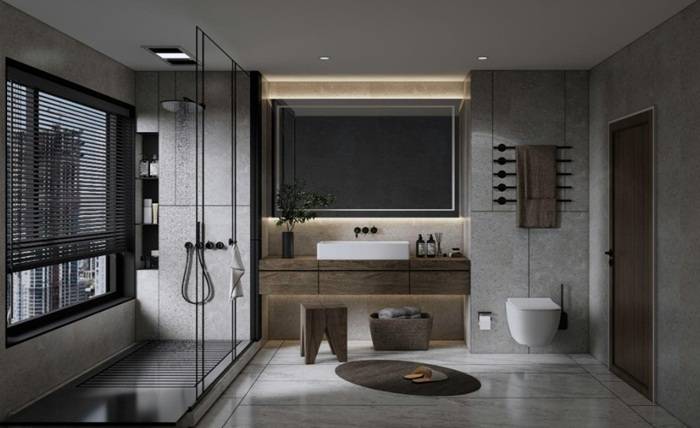
Grey bathrooms have had a remarkably long run. They are tidy, versatile and usually work with any style. But when cool-grey tile meets grey cabinetry, chrome fittings and bright-white paint, the overall impression may turn into sad corridor rather than personal space for relaxation.
The good news is that a bland grey bathroom rarely needs a costly demolition to gain personality. A few deliberate shifts in warmth, texture, lighting and proportion can make a lot of difference. Read along to find out more.
Start by warming the undertone
Not all greys are created equal. Blue-grey tile can make a bathroom feel crisp, but it can also become chilly under standard cool-white bulbs. The simplest remedy is to introduce warmer neighbouring colors rather than fight the tile itself.
Think toasted oak, tobacco-toned baskets, brushed brass, antique bronze and creamy whites in place of stark optic white. A mushroom, putty or soft clay paint on the walls can make existing grey ceramic feel more welcoming, especially if the paint has a little brown or red in its base. This is a paint-and-accessories intervention, not a renovation, yet it changes the temperature of the entire room.
Replace the jewellery
A bathroom is a small room with a great deal of hardware. That is fortunate for anyone watching their budget: taps, cabinet pulls, towel hooks, mirror frames and lighting deliver a lot of visual presence per square metre.
If your grey bathroom currently has polished chrome everywhere, choose one warmer metal for the pieces you can change easily. A pair of aged-brass cabinet knobs, a slim black-framed mirror or a bronze towel rail gives the space contrast and rhythm. There is no need for a perfectly matched suite; in fact, a little variation looks even better. The rule is simply to repeat a finish at least twice so it creates consistency.
Give flat surfaces some tactility
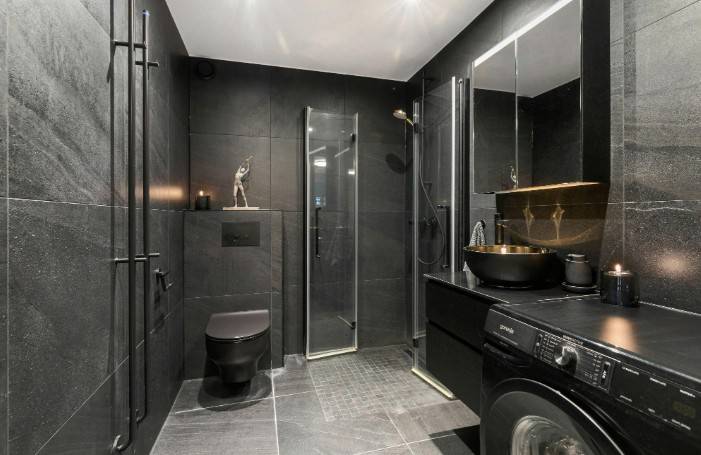
The real issue with many grey bathrooms is not colour so much as uniformity. Smooth grey floor tile, smooth grey wall tile and smooth grey cabinetry all absorb the light in much the same way. However, texture quickly fixes that.
Start with the softest layer. A thick cotton bath mat in warm ivory, cinnamon or mossy green is a modest purchase with a disproportionately luxurious effect. Add a waffle towel, a pleated linen blind, a timber stool or a ribbed-glass container. These elements bring the slight irregularities that keep a bathroom from feeling too plain.
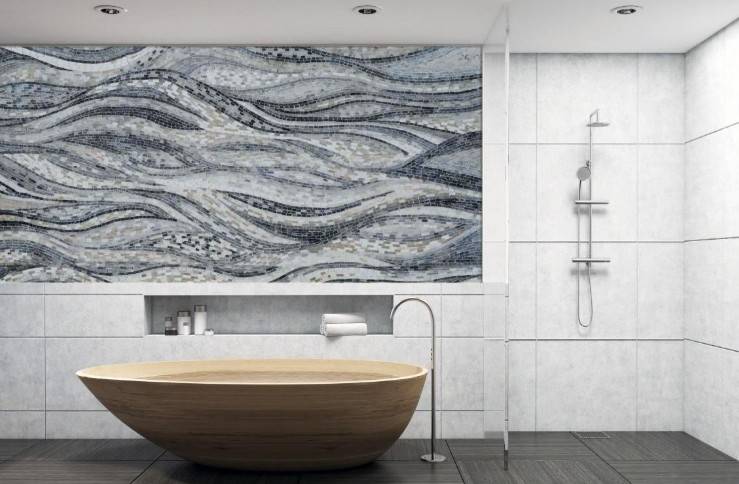
If a tile update is possible, use it sparingly. Instead of retiling the entire room, treat one niche, splashback or narrow vertical strip as an accent. A mosaic shower wall can bring movement and a sense of craft to an otherwise plain enclosure without requiring you to touch the floor or move a fitting. Keep the surrounding tile quiet and let the smaller surface do the expressive work.
Make lighting do some of the decorating
Harsh overhead light is particularly unkind to grey. It flattens texture, exaggerates cool undertones and makes even excellent finishes feel a little lifeless. A layered lighting is a solution.
Choose warm-white bulbs, generally around 2700K to 3000K, and place lighting on either side of the mirror where possible. This is more flattering for faces than a single fitting overhead and produces a more dimensional wash across tile. If rewiring is outside the budget, a plug-in sconce near the vanity or a rechargeable, damp-rated accent light can still help.
Bring in a little pattern, but keep it limited
Pattern is the quickest way to interrupt a grey-on-grey scheme, but it need not mean committing to a floor of graphic tile. A patterned shower curtain, a vintage-style runner in a generous bathroom, or a framed botanical print immediately make the space more vibrant.
The most expensive-looking version of this idea is well-balanced. Choose a pattern that repeats a tone already in the room, such as olive against charcoal grey or rust against soft concrete, then leave the rest of the surfaces plain. This way, you can both save your budget and make sure your bathroom doesn’t get overwhelmed with all different patterns and colors.
For a more permanent flourish, natural stone mosaics in a small niche or behind a basin add variation in tone that manufactured grey tiles can’t achieve. You can treat it as a piece of functional art that combines durability and textured aesthetics.
Use living colour, not more décor
Bathrooms need not become mini living rooms. The few accessories they do have should earn their place. A leafy plant that tolerates humidity, a branch in a simple vessel, a bar of beautifully wrapped soap and a good-looking hand towel can be enough.
If there is no natural light, skip the aspirational fern and opt for a convincing faux stem or a small piece of art. A bathroom is already full of hard, reflective materials; one organic detail softens the perception.
Edit before you add
The final, and least expensive, move is subtraction. Decant the rainbow of bottles, hide cleaning supplies and reduce countertop clutter to the things you genuinely use. Grey reads most elegantly when the eye can take in its tonal subtleties rather than navigate visual noise.
A grey bathroom does not need to become colourful to become interesting. It needs warmth, contrast and a little variation. Add those, and the grey begins to feel less like a compromise and more like a very chic neutral.