

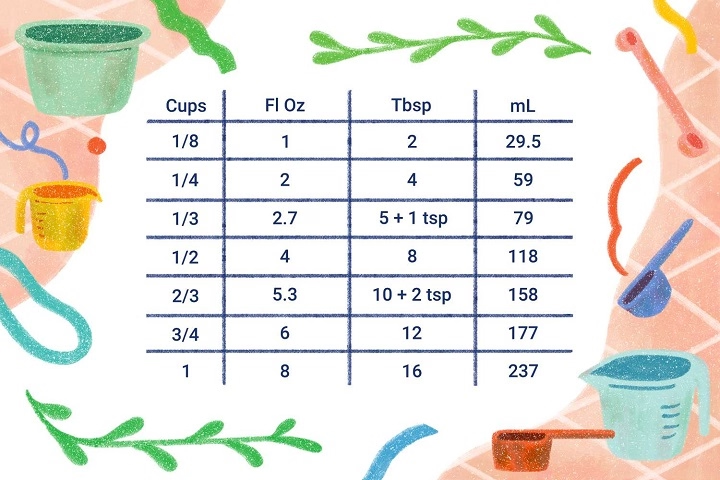
When it comes to cooking or baking, knowing how to convert measurements is essential. One of the most common questions that arise is, “How many tablespoons are in 1 ounce?” This seemingly simple query often stumps beginners and even some experienced cooks. In this article, we will break down this measurement and provide you with the answers, tips, and conversions to make your cooking experience smoother.
Understanding the Basics of Ounces and Tablespoons

To accurately measure ingredients in cooking or baking, it’s important to know the standard equivalents. A tablespoon is a unit of volume commonly used in cooking, while an ounce is also a unit of measurement for both weight and volume, depending on the context.
In the United States, a tablespoon is defined as 3 teaspoons or 1/16th of a cup, and this is what we typically use in recipes. On the other hand, an ounce can be a bit more confusing, as it can refer to both weight and volume. For the purposes of this article, we’ll focus on fluid ounces, which measure volume.
How Many Tablespoons Are in 1 Fluid Ounce?
The answer is quite simple once you know the basic conversion:
1 fluid ounce (fl oz) = 2 tablespoons (tbsp)
This is a standard conversion for liquid ingredients, making it easy to scale recipes. So, if you need 1 ounce of liquid for your recipe, you can use 2 tablespoons.
It’s essential to distinguish between weight and volume when measuring ingredients. For dry ingredients, the conversion can vary slightly, as their density affects the weight-to-volume ratio.
Converting Other Common Measurements
When you’re in the kitchen, it’s often necessary to convert different measurements for ease. Here are some common conversions you might find useful:
1 Fluid Ounce (fl oz) = 2 Tablespoons (tbsp)
1 Cup = 16 Tablespoons (tbsp)
1 Teaspoon (tsp) = 1/3 Tablespoon (tbsp)
1 Cup = 8 Fluid Ounces (fl oz)
1 Tablespoon (tbsp) = 15 Milliliters (ml)
Understanding these conversions will help you switch between different units with ease, especially when you’re following recipes that use various measurements.
The Importance of Accurate Measurements in Cooking
Accurate measurements are crucial when it comes to cooking and baking. For example, when following a recipe for a cake, even a small variation in the amount of liquid or dry ingredients can affect the texture, flavor, or structure of the dish. Inaccurate measurements can lead to too much salt, flour, or sugar, which can result in an undesired outcome.
Baking vs Cooking: Why Measurements Matter
In baking, precise measurements are especially important. Since baking is more of a science than an art, the balance of ingredients plays a significant role in achieving the right consistency, flavor, and appearance. For example, 1 tablespoon of baking powder can have a different effect on your recipe depending on whether it’s measured accurately or not.
On the other hand, cooking recipes often allow for more flexibility, but that doesn’t mean measurements aren’t important. When cooking sauces, gravies, or soups, using the correct amount of liquid can influence the final texture and taste.
Factors to Consider When Converting Measurements

While conversions like “how many tablespoons in an ounce” seem straightforward, there are a few factors that can affect measurements:
- Density of Ingredients: As mentioned, the weight-to-volume ratio can vary for dry ingredients. For instance, 1 ounce of sugar is not the same as 1 ounce of flour in terms of volume.
- Measurement Tools: Ensure you are using the correct measuring spoons and cups. The size of spoons and cups can differ between manufacturers, leading to slight inaccuracies.
- Liquids vs Dry Ingredients: As mentioned, liquid measurements are more consistent, but dry ingredients such as flour, sugar, or salt can vary in volume based on how they are packed into the measuring spoon.
Helpful Tips for Accurate Measuring
To ensure you’re getting accurate measurements in the kitchen, here are some tips:
Use the Right Tools
Invest in high-quality measuring spoons and cups that are clearly marked. Metal spoons are often more accurate than plastic spoons for dry ingredients.
Level Off Dry Ingredients
When measuring dry ingredients, use a flat edge, such as a knife or spatula, to level off the top of the measuring spoon or cup. This ensures you’re getting the exact amount.
Check Fluid Measurements at Eye Level
For liquid measurements, place the measuring cup on a flat surface and check the measurement at eye level. This helps you avoid over-pouring or under-pouring.
Don’t Over-Pack Ingredients
When measuring ingredients like flour or powdered sugar, avoid packing them into the measuring spoon or cup. Spoon the ingredient into the cup, then level it off.
Be Precise in Baking
In baking, even a small error in measurement can lead to a failed recipe. It’s always best to use a scale for dry ingredients and use liquid measurements for liquids.
FAQs About Tablespoons and Ounces
How many tablespoons are in 1 ounce of water?
1 ounce of water is equal to 2 tablespoons. This holds true for most liquid ingredients.
How do I convert ounces to tablespoons for dry ingredients?
While 1 ounce equals 2 tablespoons for liquids, the equivalent for dry ingredients may vary. For example, 1 ounce of flour is roughly 2 tablespoons, but the amount can differ based on the ingredient’s density.
Can I use a tablespoon to measure both liquid and dry ingredients?
Yes, you can. However, it’s essential to account for the difference in density when measuring dry ingredients. Liquids are easier to measure accurately.
Is 1 tablespoon the same in all countries?
No, the size of a tablespoon can vary between countries. In the U.S., a tablespoon is equivalent to 15 milliliters, but in other countries like the UK and Australia, it may be slightly different.
How can I convert tablespoons to teaspoons?
To convert tablespoons to teaspoons, multiply the number of tablespoons by 3. For example, 1 tablespoon equals 3 teaspoons.
Knowing how many tablespoons are in 1 ounce (2 tablespoons) is an essential piece of cooking knowledge. It helps ensure that your ingredients are measured accurately, whether you’re preparing a simple soup or a complex cake. Accurate measurements make a difference in the outcome of your dishes, ensuring better taste, texture, and presentation. By understanding these conversions and following best practices, you can enhance your cooking skills and achieve consistently delicious results.