

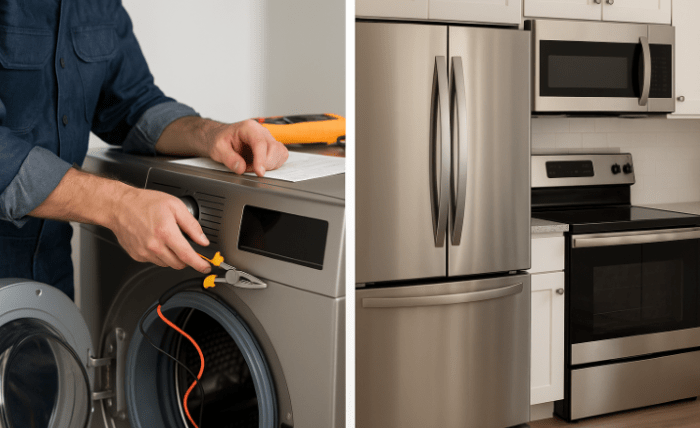
There’s a moment every homeowner dreads: a fridge that suddenly stops cooling, a dryer that won’t heat, or a washer that refuses to spin. The question always comes up — is it worth fixing, or is it time to replace it? After years in the field working on every kind of appliance you can name, I can tell you: there’s no one-size-fits-all answer. But there are patterns, and with the right knowledge, the decision becomes a lot easier.
I’ve worked on hundreds of machines — some were fixed in under an hour and lasted for years after; others looked fine on the outside but were no longer worth saving. What people often miss is that the real cost isn’t just the repair bill — it’s what you’re getting in return: reliability, time, and safety. That’s where good judgment and honest technical advice come in.
Understanding the Trade-Off
At the core of every decision is one simple question: will the repair actually extend the life of the appliance in a meaningful way? In many cases, the answer is yes — especially with newer or well-maintained units. I’ve replaced thermal fuses, door switches, belts, and capacitors that cost under $100 in total, and those machines kept working like new. But in other cases, especially with older appliances, it’s not so clear-cut.
Let me give you a practical example. I had a customer with a 12-year-old fridge that wasn’t cooling. The compressor had failed. That part alone cost over half of what a new fridge would, not to mention labor. In that case, I advised against the repair — and they agreed. But a week later, another client called about a noisy dryer. Turned out it was just a worn drum roller. I replaced it, and the unit ran quietly again for another three years.
The point is, you have to weigh the value of the appliance against the type of failure — and whether the repair brings the unit close to “like new” condition again.
Repair vs Replacement – A Technician’s Comparison
When Repair Makes Sense
If the appliance is under 7–8 years old and hasn’t had major issues before, repairs are often a smart choice. Modern appliances are built to last at least a decade with proper use. I’ve seen washers from 2016 running strong after just a minor pump replacement. Especially with common brands and available parts, the fix is fast and cost-effective.
When Replacement Is Smarter
If the unit is nearing the end of its lifespan, has multiple past repairs, or needs a high-cost part like a sealed system or control board, replacement starts to make more sense. Especially with refrigerators or ovens, where the internal components are difficult to access, the repair can quickly snowball into something more complex — and expensive.
Cost, Safety, and Long-Term Value
From a cost perspective, I always ask clients to think beyond the immediate repair fee. Will this fix buy you another 5 years — or just a few months? A smart repair is an investment; a bad one is just delaying the inevitable.
And then there’s safety. I’ve come across DIY attempts that made my job harder — and more dangerous. One customer tried to fix a microwave that kept sparking. He didn’t realize the capacitor inside still held a high-voltage charge. That’s not just risky — it’s life-threatening. My rule is simple: if the repair involves electrical components, heating elements, or sealed systems — don’t open it yourself. Home appliances are deceptively complex, and electricity doesn’t forgive mistakes.
That’s why companies like Superior Appliances Repair matter. With the right tools, training, and diagnostic skills, professionals don’t just fix a symptom — they catch the real issue, often preventing future breakdowns.
Choosing between appliance repair and replacement isn’t just about numbers. It’s about understanding what you’re working with, what the problem truly is, and what kind of lifespan you can expect afterward.
In my work, I’ve learned that a well-done repair can restore reliability and peace of mind — but only if the situation calls for it. If the appliance is beyond saving, I always tell my clients the truth, even if it means losing the job. That honesty is part of what makes a good technician.
So next time something breaks, take a moment before you rush into buying new or calling the cheapest repair number. Think long-term. Ask questions. And always, always prioritize safety. Making the right decision now can save you time, money, and stress for years to come.