


Aaron Hernandez’s rise from a talented football player to an NFL star, followed by his shocking downfall and tragic death, remains one of the most controversial and haunting stories in sports history. His journey from athletic success to becoming entangled in criminal activity captivated the public’s attention and left many wondering how a man with so much promise could have fallen so far. In this comprehensive exploration of Aaron Hernandez’s life, career, and the circumstances that led to his tragic end, we examine the complexities of his story, the factors that contributed to his downfall, and the lasting impact his life has had on the NFL and society.
Early Life and Athletic Promise

Aaron Josef Hernandez was born on November 6, 1989, in Bristol, Connecticut. Raised in a working-class family, Hernandez was one of two sons born to Dennis Hernandez and Terri Valentine-Hernandez. From an early age, it was clear that Aaron had immense athletic talent. His father, Dennis, was a former high school athlete who pushed Aaron and his brother, D.J., to excel in sports. Aaron’s relationship with his father was complex—while Dennis was a strict disciplinarian who demanded perfection, he was also someone Aaron admired deeply.
Tragedy struck when Aaron was 16, as his father passed away unexpectedly due to complications from hernia surgery. The loss of his father was a turning point in Aaron’s life, with friends and family noting that his behavior changed significantly afterward. Despite this, Aaron channeled his grief into football and became one of the top high school prospects in the country.
A Star at the University of Florida
Aaron Hernandez’s football talents earned him a scholarship to play for the University of Florida, where he played under legendary coach Urban Meyer. At Florida, Hernandez quickly became one of the top tight ends in college football. He was a key part of the team’s success, helping the Gators win the BCS National Championship in 2009.
Hernandez’s combination of size, speed, and athleticism made him a matchup nightmare for defenses. He was named a consensus All-American in 2009 and won the John Mackey Award as the nation’s best tight end. On the field, he was a star, but off the field, Hernandez’s behavior raised red flags. There were reports of violent outbursts, drug use, and questionable associations with people involved in criminal activity, but his immense talent kept him on the field.
NFL Career: Drafted by the New England Patriots
Despite his collegiate success, Hernandez’s off-field concerns caused him to slide in the 2010 NFL Draft. Initially projected as a first-round talent, he fell to the fourth round, where the New England Patriots selected him with the 113th overall pick. The Patriots, known for their strict culture and success under head coach Bill Belichick, believed they could help Hernandez reach his potential while keeping his personal issues in check.
Hernandez immediately made an impact in the NFL. In his rookie season, he recorded 45 receptions for 563 yards and six touchdowns, forming a dynamic tight end duo with Rob Gronkowski. The Patriots utilized Hernandez’s versatility, lining him up as a receiver, in the backfield, and even occasionally at running back. By his second season, Hernandez was regarded as one of the league’s most promising young players.
In 2012, the Patriots rewarded Hernandez with a five-year, $40 million contract extension, cementing his place as a cornerstone of the franchise’s future. However, despite his on-field success, troubling signs continued to emerge in Hernandez’s personal life.
Off-Field Troubles and Dark Associations
Throughout his time with the Patriots, Aaron Hernandez’s life away from football was filled with turmoil. He maintained relationships with people from his hometown of Bristol, many of whom were involved in criminal activities. Hernandez’s behavior became more erratic, and his violent tendencies, which had been hinted at during his college years, began to surface more frequently.
Reports of bar fights, altercations with teammates, and unsettling behavior began to follow Hernandez. There were whispers that he was involved in gang activity, and he continued to use drugs, particularly marijuana. While the Patriots organization was aware of some of his issues, the extent of Hernandez’s troubles would not come to light until much later.
Also Read: Danny Amendola: The Unsung Hero of the NFL
The Murder of Odin Lloyd
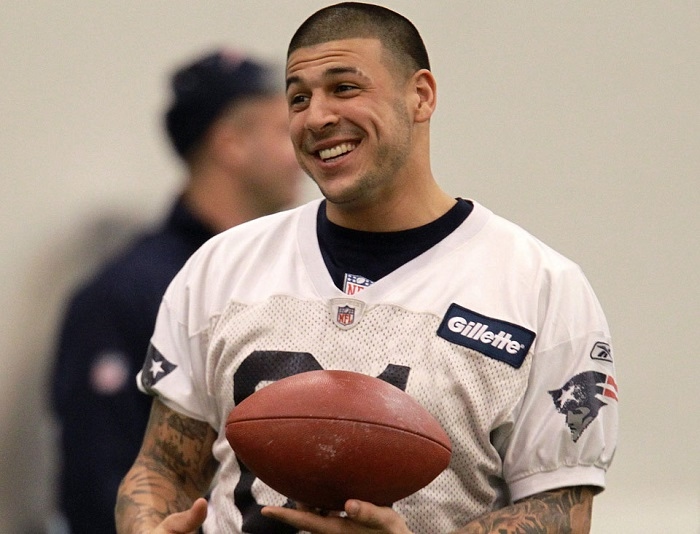
On June 17, 2013, the body of Odin Lloyd, a semi-professional football player who was dating the sister of Hernandez’s fiancée, was found in an industrial park near Hernandez’s home in North Attleboro, Massachusetts. Lloyd had been shot multiple times. Within days, Hernandez became the prime suspect in the murder investigation.
The case quickly became a media sensation. Hernandez’s connection to Lloyd, coupled with his NFL stardom, made the story one of the most talked-about in sports and crime circles. On June 26, 2013, Hernandez was arrested and charged with first-degree murder. The Patriots released him within hours of his arrest, cutting ties with the once-promising tight end.
The Trial and Conviction
Aaron Hernandez’s trial for the murder of Odin Lloyd began in January 2015. The prosecution argued that Hernandez had orchestrated Lloyd’s killing because he feared Lloyd knew too much about his involvement in other criminal activities. The evidence against Hernandez was overwhelming—surveillance footage, text messages, and witnesses placed him at the scene of the crime.
In April 2015, Hernandez was found guilty of first-degree murder and sentenced to life in prison without the possibility of parole. The conviction was a stunning fall from grace for the former NFL star, and it marked the beginning of the end of his tragic story.
The Double Homicide Case and Acquittal
While serving his sentence for the murder of Odin Lloyd, Hernandez faced additional legal troubles. He was charged with a double homicide in connection with the deaths of Daniel de Abreu and Safiro Furtado, two men who were killed in a drive-by shooting in 2012. Prosecutors alleged that Hernandez shot the men after a confrontation at a nightclub.
Despite the serious nature of the charges, Hernandez was acquitted of the double homicide in April 2017. His acquittal provided a brief glimmer of hope for those who believed Hernandez might still turn his life around, but that hope would be short-lived.
Hernandez’s Death: A Tragic End
On April 19, 2017, just five days after being acquitted of the double homicide, Aaron Hernandez was found dead in his prison cell. He had committed suicide by hanging himself with a bedsheet. Hernandez’s death shocked the sports world and led to a series of questions about what might have driven him to take his own life.
In the aftermath of his death, it was revealed that Hernandez had been suffering from chronic traumatic encephalopathy (CTE), a degenerative brain disease linked to repeated head trauma. The condition, commonly found in former football players, has been associated with violent behavior, mood swings, and cognitive impairment. An examination of Hernandez’s brain revealed that he had one of the most severe cases of CTE ever found in a person of his age.
The Role of CTE in Hernandez’s Behavior
The discovery of CTE in Aaron Hernandez’s brain added a complex layer to his already tragic story. Many began to question whether the disease had played a role in his increasingly erratic and violent behavior. CTE has been linked to a range of psychological issues, including depression, aggression, and suicidal thoughts. Hernandez’s case reignited the conversation about the long-term effects of playing football and the NFL’s handling of player safety.
Aaron Hernandez’s story is one of immense talent, squandered potential, and devastating tragedy. His rise from a high school football phenom to an NFL star, followed by his shocking fall into a life of crime, captivated the public’s attention. Hernandez’s life serves as a cautionary tale about the pressures and temptations that come with fame and fortune, as well as the potential impact of brain injuries on athletes.
Hernandez’s legacy remains complicated. While he will always be remembered for his incredible abilities on the football field, his involvement in violent crimes and his eventual death overshadow his achievements. His life and death also continue to raise important questions about mental health, CTE, and the responsibilities of sports organizations in caring for their players.
In the end, Aaron Hernandez’s story is a reminder of how quickly a life filled with promise can spiral out of control—and how the consequences of that fall can reverberate far beyond the individual.