

Cooking and baking require precision, especially when adjusting recipes to serve more people. One common question that arises is how to double 3/4 cup accurately. To find the answer, simply multiply 3/4 by 2.
3/4 × 2 = 6/4 = 1 1/2 cups
This means that when a recipe calls for 3/4 cup and you need to double it, the correct measurement is 1 1/2 cups. Whether you are preparing a larger meal, meal prepping for the week, or adjusting ingredient amounts for a specific pan size, understanding how to correctly double measurements ensures your recipe turns out as expected.
Why Accurate Measurements Matter in Cooking and Baking
Precision is essential in both cooking and baking, but it is even more crucial when working with baked goods. The correct balance of ingredients ensures the right texture, taste, and consistency. If measurements are not doubled correctly, the final result may be too dry, too runny, or not hold its shape.
Doubling a recipe requires adjusting all ingredients proportionally. Mistakes such as doubling only certain ingredients while leaving others the same can lead to an imbalanced dish. Learning how to correctly scale measurements helps avoid errors and improves cooking efficiency.
Kitchen Measurement Conversion Chart
Having a reliable reference for doubling common cup measurements can make kitchen tasks easier. The following table provides a quick guide for doubling different cup amounts.
| Original Measurement | Doubled Measurement |
| 1/4 cup | 1/2 cup |
| 1/3 cup | 2/3 cup |
| 1/2 cup | 1 cup |
| 3/4 cup | 1 1/2 cups |
| 1 cup | 2 cups |
This chart is useful when increasing recipe sizes, ensuring accurate ingredient proportions.
Differences Between Dry and Liquid Measurements
When doubling measurements, it is important to use the correct measuring tools for dry and liquid ingredients.
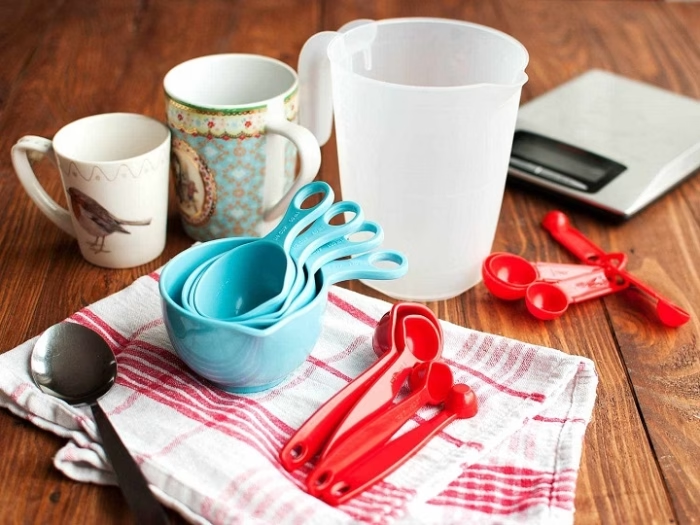
Dry ingredients such as flour, sugar, and cocoa powder should be measured using dry measuring cups. These cups allow for leveling off excess ingredients to achieve accurate amounts. Scooping directly from a bag can cause incorrect measurements, so it is best to spoon dry ingredients into the cup and level it with a flat edge.
Liquid ingredients such as milk, water, and oil should be measured in a liquid measuring cup. These cups have spouts for easy pouring and markings to indicate precise amounts. Placing the measuring cup on a flat surface and checking at eye level ensures accuracy.
Measuring 1 1/2 Cups Without a Measuring Cup
If a 1 1/2-cup measuring cup is unavailable, alternative measuring techniques can be used to ensure accuracy.
- Three 1/2-cup measurements equal 1 1/2 cups.
- One 1-cup measurement plus one 1/2-cup measurement equals 1 1/2 cups.
Using smaller measuring cups to reach the correct total helps maintain accuracy when doubling 3/4 cup.
Tips for Accurate Kitchen Measurements

Using proper measuring techniques prevents common mistakes in cooking and baking. Here are some tips to ensure accuracy:
- Level off dry ingredients with a straight edge to remove excess and prevent over-measuring.
- Use the correct measuring tools designed for dry and liquid ingredients.
- Stir dry ingredients before measuring to ensure even consistency.
- Avoid tapping or shaking measuring cups, as this can cause ingredients to settle and lead to incorrect measurements.
- When measuring sticky ingredients such as honey or syrup, lightly coat the measuring cup with oil to allow for easy pouring and accurate measurement.
Applying these techniques improves consistency in recipes and enhances the quality of the final dish.
Understanding Kitchen Fractions and Their Equivalents
When doubling 3/4 cup, understanding fractions and their equivalents can be helpful.
3/4 cup is equal to:
- 12 tablespoons
- 36 teaspoons
- 6 fluid ounces
When doubled, the new amount is:
- 24 tablespoons
- 72 teaspoons
- 12 fluid ounces
Knowing these conversions allows for flexibility when measuring without specific cups or spoons.
When Doubling Recipes Requires Adjustments
Doubling ingredients works well in many recipes, but some dishes require more adjustments beyond simple multiplication. Baking recipes, for example, depend on specific ingredient ratios to maintain structure and texture.
For example, when doubling a cake recipe, leavening agents such as baking powder and baking soda may need to be increased differently. Simply doubling them can cause the batter to rise too much or collapse. A general rule is to increase leavening agents by one and a half times rather than doubling them.
Liquids also require careful adjustments. In some cases, too much liquid can make a dish too runny, while too little can make it dry. Observing the consistency of the batter or dough helps determine if extra adjustments are needed.
How to Convert 3/4 Cup to Other Measurements
Some recipes list ingredients in different units. Being able to convert measurements makes following recipes easier.
| Measurement Type | 3/4 Cup | Doubled |
| Tablespoons | 12 tbsp | 24 tbsp |
| Teaspoons | 36 tsp | 72 tsp |
| Fluid Ounces | 6 fl oz | 12 fl oz |
These conversions help when recipes use different measuring systems.
Frequently Asked Questions
What is half of 3/4 cup?
Half of 3/4 cup is 3/8 cup, which is equal to 6 tablespoons.
How many tablespoons are in 3/4 cup?
There are 12 tablespoons in 3/4 cup. Doubling it results in 24 tablespoons or 1 1/2 cups.
How do I convert 3/4 cup to ounces?
Since 1 cup equals 8 ounces, 3/4 cup is 6 ounces. Doubling it results in 12 ounces.
How can I measure 1 1/2 cups without a measuring cup?
If a 1 1/2-cup measuring cup is unavailable, three 1/2-cup measurements or one 1-cup measurement plus one 1/2-cup measurement can be used.
How can I triple 3/4 cup?
To triple 3/4 cup, multiply by 3. The result is 2 1/4 cups.
Can I use a drinking cup to measure?
Drinking cups vary in size and are not standardized, so using proper measuring cups ensures accuracy.
Doubling 3/4 cup is a simple yet important calculation when adjusting recipes. Whether increasing portions for a larger group or preparing meals ahead of time, understanding kitchen conversions makes the process easier. Measuring accurately ensures consistency in recipes, whether baking a cake, making soup, or preparing sauces.
Using the right tools, understanding fractions, and following proper measuring techniques improves success in the kitchen. Keeping a measurement conversion chart handy helps when adjusting recipes, preventing errors, and maintaining balanced flavors.
Scaling up recipes should always be done carefully, especially in baking, where ingredient proportions affect the final outcome. Learning to measure accurately, use the right equipment, and recognize when adjustments are needed ensures the best possible results.